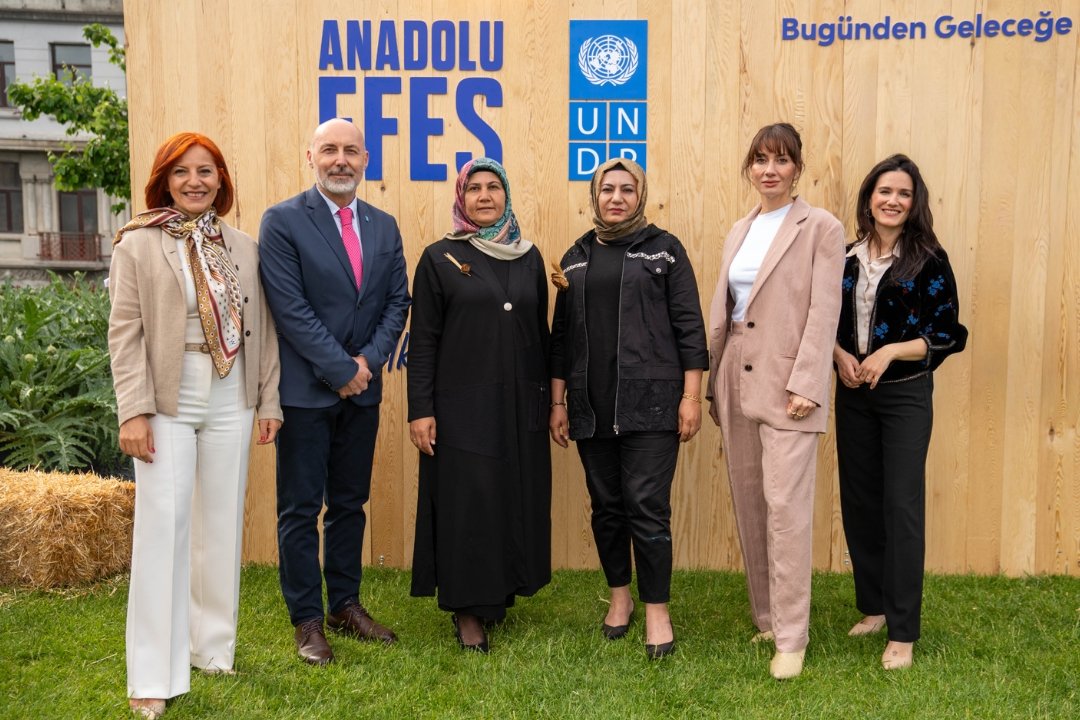

Beverage manufacturer Anadolu Efes and the United Nations Development Programme Türkiye have established a circular economy project called Second Harvest. The initiative repurposes agricultural waste barley stalks into raw design materials, utilising local female artisans in Adıyaman to drive regional economic development.
The scheme runs with the Eliyaman Women’s Initiative Cooperative, Fortuna Women Entrepreneurs Cooperative and the MILKist Social Design Center. Artworks are sold via online auctions, with proceeds transferred back to the cooperatives. Ten artists have contributed 16 pieces, which will feature at the Fashion Institute of Technology in New York this September.
Selda Susal Saatçi, Anadolu Efes Group Chief Corporate Communications and Affairs Officer, said: “Today, the global economy still largely operates on a ‘take, make, consume, and dispose’ model. However, at a time when resources are becoming increasingly critical, the circular economy approach is gaining greater importance every day from a sustainability perspective. According to the Circularity Gap Report 2026 by Circle Economy, the world experiences an annual value loss of approximately EUR 25.4 trillion. This picture makes it necessary for companies to go beyond simply consuming less and instead establish systems that redesign products, reintegrate waste into production processes, and reduce value loss. As Anadolu Efes, we approach sustainability not only through environmental targets, but also from the perspectives of agriculture, social development, and local production. We care not only about expanding the impact we create, but also about ensuring its long-term permanence. This understanding lies at the heart of our ‘Deepening Impact’ approach. Our story begins with the soil. We source two of our four main raw materials directly from the land. We see the future of the soil as the future of production, and we focus on improving soil health through regenerative agriculture practices. Through the Second Harvest project, implemented in partnership with UNDP Türkiye, we aim to demonstrate how agricultural by-products can be transformed into renewed value.”
Ceyda Alpay, Economic Growth and Competitiveness Portfolio Manager at the United Nations Development Programme Türkiye, said: “As UNDP, we have built a strong partnership with Anadolu Efes in the field of sustainability spanning nearly 17 years. ‘Second Harvest’ presents a highly valuable model that brings together the reutilization of agricultural by-products with women’s empowerment and local development. We believe that this approach – in which women are positioned at the center of production processes – can be replicated across different regions and adapted to different agricultural products. What truly matters is the approach itself: recognizing and revaluing an existing local resource, placing women’s labor and knowledge at the center, increasing added value through design and market linkages, and considering all of this together with environmental benefits. Second Harvest actually reminds us of something powerful: once one harvest ends, another can begin. The first harvest comes from agriculture; the second harvest emerges from women’s labor, creativity, and the new value chains built collectively. We believe that this model, which combines the circular economy approach with social impact, can serve as an inspiring example for different regions as well.”
Birnur Temel Birtane, Founder of the MILKist Social Design Center, stated: “Second Harvest is not merely a project focused on transforming agricultural waste into secondary raw materials; it is a multilayered process that makes visible the knowledge embedded in the soil, local production culture, and the role of agriculture as a starting point for different sectors. Within this project, women become not only producers, but also stakeholders who carry and transfer knowledge into the future. While building new connections between agriculture and design, we aim to develop more sustainable production models together with artists and designers from different disciplines.”