

Emerging markets are facing a growing capital drain that is reshaping the rules of corporate risk. Rising debt servicing obligations and tighter global financial conditions are forcing many developing economies to channel increasing portions of national income towards foreign creditors, often at the expense of domestic investment and social spending. This is no longer viewed as a temporary distortion or a peripheral sovereign risk concern. Across several high growth frontier economies, it has become an increasingly entrenched operating reality, triggering fiscal pressures that traditional corporate balance sheets frequently fail to account for, particularly the disproportionate economic burden placed on the female workforce
This fiscal contraction is accelerating as global borrowing hits unmapped territory. Fresh data tracking sovereign liabilities shows that gross global government debt has swelled to a record $111 trillion, while total public and private liabilities have surged past $348 trillion. According to the OECD Global Debt Report 2026, annual market borrowing by governments and corporations has escalated to an unprecedented $29 trillion, representing a 17 per cent jump in just a two-year window.
This macro-expansion comes at a brutal premium for frontier economies. UN Trade and Development (UNCTAD) metrics show that within this wider debt stack, developing nations are locked under a $31 trillion public debt burden that exacts nearly $921 billion in annual interest outflows. This has structurally altered the operating landscape. Sixty-one developing nations now allocate more than 10 per cent of their total government revenue exclusively to servicing net interest rather than investing in national infrastructure or workforce pipelines. For multinational enterprise leaders, these numbers do not just represent abstract economic friction. Instead, they document a sharp, ongoing degradation of state capacity, consumer market viability and workforce stability across the world’s primary growth corridors, creating an operational environment where women ultimately absorb the heaviest financial shock.
Capital Contraction and Its Impact on Labour Market Stability
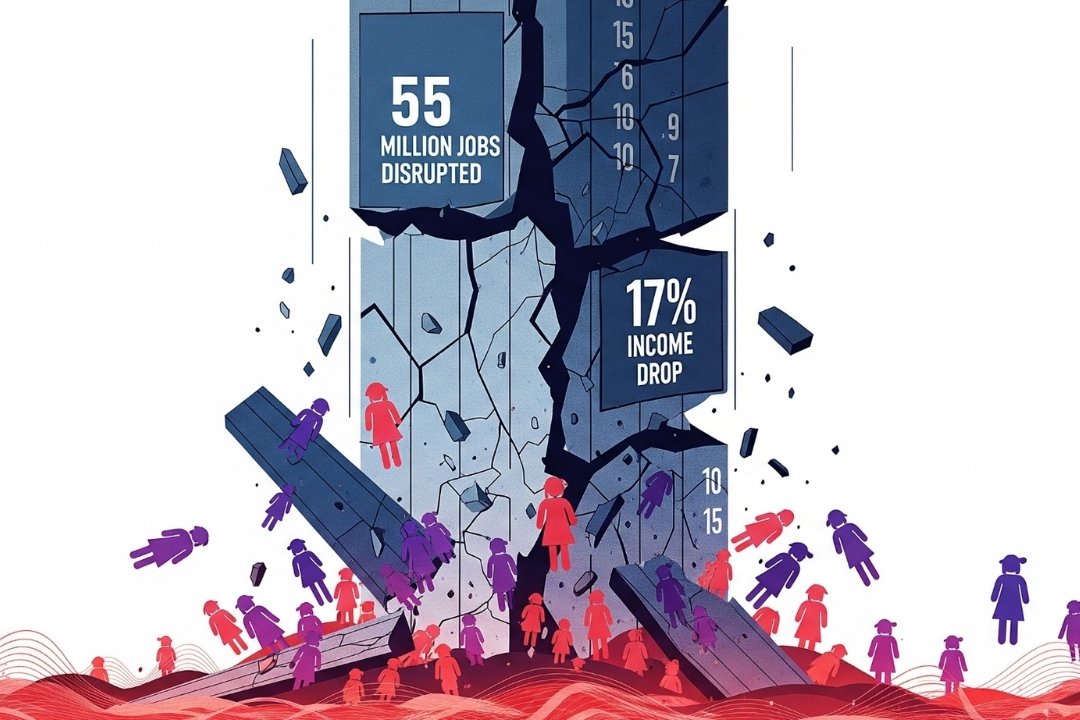
A definitive evaluation by the United Nations Development Programme under its EQUANOMICS initiative highlights how sovereign debt escalations directly destabilise the primary workforce. The landmark report, titled Who Pays the Price? Gender Inequality and Sovereign Debt, reveals that when a state moves from a moderate to a high debt-repayment model, the shift disrupts the equivalent of 55 million jobs held by women in the short term. This initial shock compounds over time, threatening up to 92.5 million female positions through structural feedback loops across local economies. The commercial implications are compounded by a stark income divergence. While male earnings remain statistically flat during fiscal adjustments, female per capita income plummets by 17 per cent, creating a substantial and unpriced gender compensation gap across frontier operating environments.
From a corporate strategy perspective, a 17 per cent drop in female per capita income across emerging markets represents a severe threat to downstream product demand. Women operate as the primary operational managers of household consumption in these regions, making their financial liquidity a critical bellwether for market viability. Multiplier data frequently published by the World Bank and the Harvard Kennedy School establishes that female workers route up to 90 per cent of their revenue straight back into local supply chains through health, education and consumer goods. This is in stark contrast to male workers, who average a capital reinvestment rate of 30 to 40 per cent. Consequently, depressing female purchasing power triggers an immediate compounding contraction across local business ecosystems, impairing everything from corporate consumer retail volumes to long-term human capital metrics.
Data from the World Economic Forum’s Global Gender Gap Report 2025 underscores the severe concentration risk built into the female labour supply. According to the index, women comprise 58.5 per cent of the global workforce in healthcare and care operations, alongside 52.9 per cent in the educational sector. Because these specific public domains are routinely prioritised for consolidation when sovereign fiscal pressures escalate, the female workforce experiences a disproportionate volume of redundancy risk.
Studies from the Centre for Economic Policy Research confirm that structural austerity measures generate a dual shock. They simultaneously dismantle the primary employment market for women and degrade the social services required to keep those women economically active. This operational friction is further compounded by monetary policy. When central banks implement interest rate hikes to suppress inflation, the resultant capital tightening systematically slows job creation across the consumer-facing service sectors where female employment is most heavily concentrated. Consequently, multinational corporations operating in these corridors face an immediate, double-sided erosion of both their domestic workforce pipelines and their localized consumer spending bases.
The Off-Balance-Sheet Labour Transfer

The central macroeconomic blind spot in international debt restructurings lies in the mispricing of essential public services. When an emerging state terminates a public service to balance its fiscal budget, that administrative function does not vanish. Instead, the operational burden is transferred directly onto the private household.
Actuarial data from the International Labour Organization indicates that uncompensated care responsibilities already exclude 708 million women from active participation in the global labor supply chain. This structural constraint is highly concentrated across key manufacturing and consumer growth corridors. In Northern Africa, 63 per cent of women outside the formal workforce cite care obligations as the primary barrier to entry, followed closely by 52 per cent across Asia and the Pacific and 47 per cent throughout Latin America and the Caribbean. Rather than representing personal demographic preferences, these figures document clear labor market distortions caused by the systematic depletion of public care infrastructure.
When a sovereign government rolls back childcare subsidies or consolidates local healthcare infrastructure to meet foreign repayment schedules, the underlying operational demand does not disappear. Instead, the cost of that social infrastructure is transferred directly off the state balance sheet, converting a formal corporate employee and taxpayer into an uncompensated domestic care provider. A policy analysis published by the Heinrich Böll Stiftung details this structural shift as a process of gendered austerity. Under this mechanism, female workers function as involuntary economic shock absorbers. They provide the hidden, unpriced physical labour required to fill the operational deficits left behind by a retreating public sector. For international enterprises, this represents a direct, unquantified erosion of the formal labour supply and a contraction of the local tax base that underpins frontier market stability.
This structural erosion is highly measurable, with 34 developing nations now spending more on external debt servicing than on health and education combined. This prioritization creates a severe, invisible productivity loss for international businesses. Between 2010 and 2025, total African sovereign debt expanded by 183 per cent while localized interest obligations surged by 132 per cent. When regional healthcare infrastructure undergoes fiscal consolidation, the operational overhead is never truly eliminated. Instead, it is simply converted into a hidden structural subsidy extracted from female labor time. For long-term institutional investors, this unpriced cost migration signals a progressively higher-risk operating environment characterized by a shrinking skilled workforce and artificial public balance sheets.
Sovereign Health Capital Depletion and Macro-Operational Risk

The structural decay of public healthcare systems under fiscal consolidation provides institutional investors with a clear metric of sovereign risk. Actuarial data compiled by the World Health Organization and UNICEF demonstrates that while global maternal mortality fell by 40 per cent historically, progress stagnated rapidly following systemic budgetary adjustments. The restriction of essential capital has severely compromised healthcare infrastructure. Multi-country survey data tracking 108 developing and emerging economies reveals that budget consolidations have reduced localized maternal care and epidemiological surveillance services by up to 70 per cent in the most exposed regions.
This containment of expenditure triggers an immediate operational bottleneck across the localized service sector. Over 50 frontier markets have reported significant workforce downsizing among health and care staff. Because women constitute the overwhelming majority of this specialized institutional workforce, these adjustments execute a dual shock. They simultaneously erase formal corporate employment opportunities and degrade the fundamental health infrastructure required to maintain workforce readiness. The resulting feedback loop drives structural economic displacement, permanently restricting local labor pools over a multi-generational horizon.
Quantitative models published in the UNDP EQUANOMICS framework establish a direct causal link between national liability levels and demographic degradation. The research demonstrates that migrating from moderate to high sovereign debt-servicing obligations induces a 32.5 per cent escalation in maternal mortality, introducing 67 additional fatalities per 100,000 live births into the localized operating environment. For corporate strategy teams evaluating frontier market risk, these mortality spikes function as leading indicators of state fragility. A sovereign administration unable to secure basic health security is fundamentally poorly positioned to maintain the wider regulatory, logistics and legal frameworks necessary to guarantee a stable corporate operating environment.
Geopolitical Bottlenecks and Capital Inversion
The operational mechanics of this structural crisis are clearly visible in Zambia’s recent financial restructuring trajectory. Zambia became the first African nation to execute a sovereign default on its foreign debt during the 2020 global pandemic. The subsequent stabilizing facility implemented by the International Monetary Fund conditioned capital injection on aggressive domestic fiscal targets, including the immediate elimination of fuel subsidies. Independent assessments by Amnesty International reveal that these rigid structural adjustment benchmarks permanently constrained the state’s capacity to allocate capital to long-term health infrastructure, even as long-term commercial repayment terms underwent restructuring.
This institutional stagnation is not isolated to a single frontier market. Only four states—Chad, Ethiopia, Ghana and Zambia initially sought comprehensive multilateral relief via the G20 Common Framework. Consolidated institutional evaluations indicate that this flagship programme has resolved less than ten per cent of the aggregate debt service liabilities burdening these four pilot nations. A primary component of this systemic inertia is the persistent negotiating deadlock between traditional Paris Club lenders and China, which now operates as the largest single bilateral creditor across the Global South. This protracted geopolitical impasse stalls debt resolution timelines across the African continent, accelerating the domestic budget cuts that directly undermine the public systems supporting female workforce participation.
The scale of this financial drain creates a fundamental misalignment in frontier market capitalization. Across the continent, African sovereign entities collectively redirected nearly $90 billion toward external debt servicing, while simultaneously facing an annual requirement of $143 billion in dedicated climate and capital infrastructure finance to fulfill Paris Agreement obligations. This macro-environmental imbalance means that net capital extraction from these developing markets is outpacing inbound direct investment. For multinational planners, this liquidity drain severely diminishes the structural resilience of frontier business environments and directly reduces the viability of local consumer demand.
The $420 Billion Capital Deficit and Parity Timelines

Actuarial modeling by UN Women indicates that a structural capital shortfall of $420 billion annually remains the primary barrier preventing full gender equality and workforce optimization within emerging economies. This deficit is exacerbated by a severe misallocation of international development finance. Grassroots entities executing ground-level operational support receive a mere 0.13 per cent of total official development assistance allocations. This capital starvation leaves the primary drivers of female labor integration severely under-resourced, forcing local markets to depend on fragmented philanthropic models rather than scalable, institutional infrastructure.
At historical development rates, quantitative baseline projections estimate that achieving equal corporate and institutional leadership representation would require 140 years, while reaching parity across national parliaments would demand 47 years. Crucially, these timelines assume a stable, forward-moving macroeconomic trajectory. The accelerating sovereign debt escalations documented by UNCTAD, the WHO and the UNDP suggest that these baselines are no longer secure. Instead, the compression of state budgets is turning sovereign debt into one of the most powerful macro-forces actively breaking down global gender parity timelines, presenting multinational organizations with a permanently disrupted talent landscape.
Strategic Interventions and International Financial Architecture

A comprehensive response requires multilateral financial institutions and sovereign governments to integrate the gendered implications of fiscal adjustments directly into baseline risk modeling before restructuring parameters are finalized. Rather than treating labor disruption as an unpriced externality to be evaluated after the fact, structural borrowing frameworks must introduce mandatory gender-based macro impact assessments. This design relies on protected infrastructure expenditure floors and systemic gender-responsive budgeting protocols to track capital variations across populations.
This administrative methodology represents a mature regulatory mechanism rather than a theoretical proposal. IMF fiscal policy tracking confirms that the global implementation of gender-responsive budgeting frameworks expanded from 40 nations in 2002 to more than 80 sovereign jurisdictions by 2017. The primary institutional failure is not a lack of diagnostic toolkits, but rather the systematic omission of these verified accounting systems from international sovereign debt management platforms.
To address this systemic gap, broader systemic overhauls are gaining significant institutional momentum. The Bridgetown Initiative, championed by Barbados Prime Minister Mia Mottley and supported by an expanding coalition of emerging economies, explicitly demands a comprehensive restructuring of the global financial architecture. The framework proposes scaling up concessional multilateral lending and implementing modern capital flexibility rules, enabling vulnerable states to safeguard vital social and health infrastructure during debt restructurings.
Aggregated macroeconomic data points, such as a $111 trillion global public debt load, can easily mask operational realities when left unanalyzed. However, the downstream microeconomic metrics provide clear leading indicators for corporate strategy. The disruption of 55 million female jobs, an escalation of 67 preventable maternal deaths per 100,000 live births and a 17 per cent contraction in female per capita income translate directly into measurable commercial vulnerabilities. For multinational enterprises, these metrics signify shrinking local consumer markets, weakening regional labor pipelines and escalating operational instability inside the exact frontier corridors targeted for corporate expansion. An international financial model that relies on the uncompensated extraction of female labor to stabilize sovereign balance sheets represents an unsustainable, unhedged bet against global market productivity.