
Generative AI has changed the economics of content production in a very short period of time. What once required specialist skills, equipment and time can now be produced in seconds. The result is a significant increase in the volume of digital content, and a corresponding difficulty in assessing its reliability.
Deepfake files grew from 500,000 in 2023 to a projected 8 million by 2025, an increase of around 900% in two years, according to cybersecurity firm DeepStrike. Europol has estimated that up to 90% of online content could be synthetically generated by 2026. Human detection of high-quality deepfake video currently stands at 24.5% accuracy, according to research compiled by Keepnet. These are not abstract concerns. Deepfake-enabled fraud exceeded $25 billion in losses in 2025 alone.
In this context, the ability to verify the origin and integrity of content has become a significant professional and commercial asset. It is also an area where women are playing a growing and well-documented role.
What the Research Shows
In April 2026, Chief, the network for senior women leaders, published research conducted in partnership with The Harris Poll. The study surveyed 1,768 respondents, including more than 1,000 senior women leaders with at least 15 years of professional experience at VP level or above.
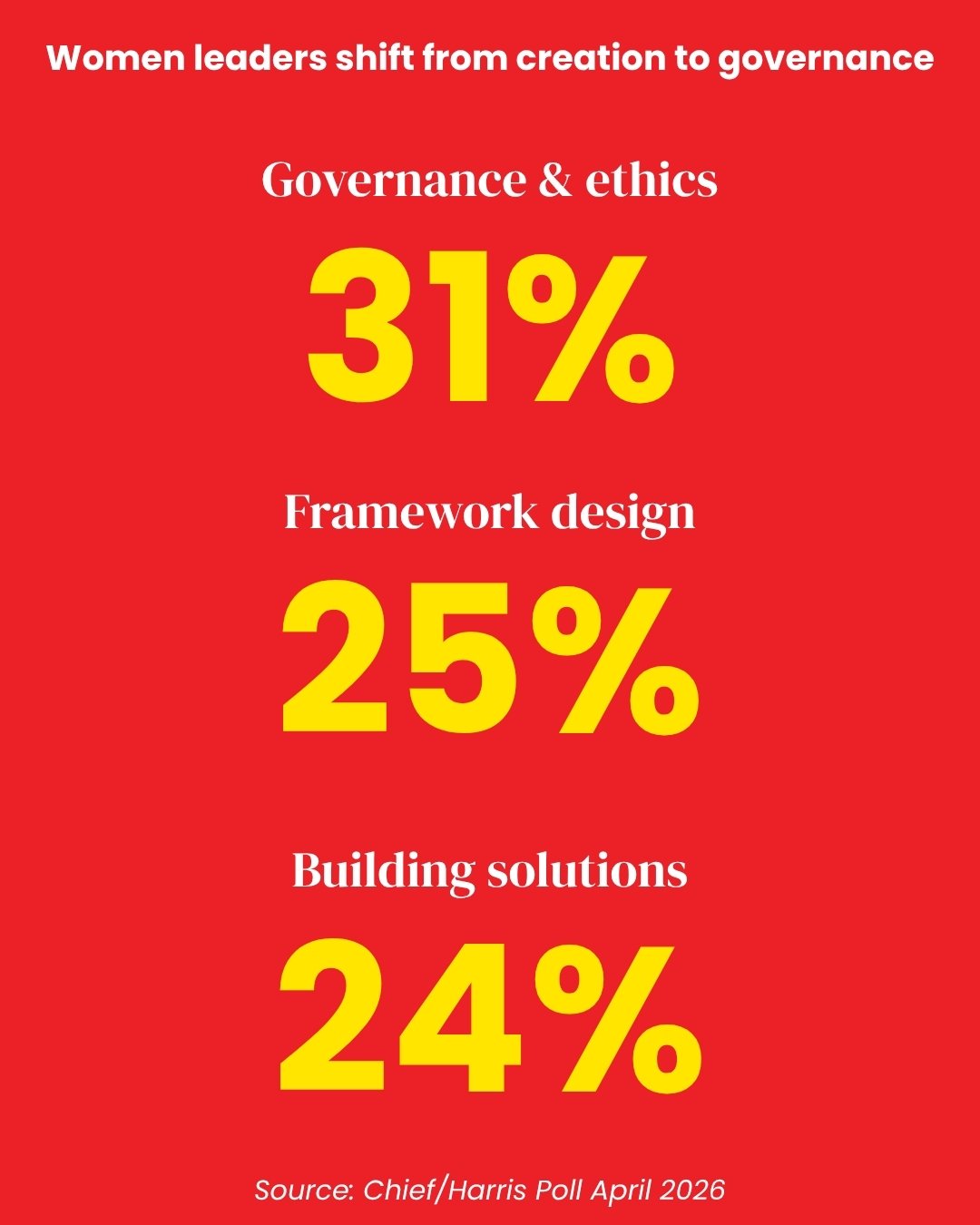
The headline finding was that 80% of women leaders are playing an active strategic role in their organisation’s AI efforts. More specifically, the largest group, 31%, described their primary function as evaluating AI governance, ethics and responsible implementation. A further 25% said they design the frameworks through which humans and AI work together in their organisations. Only 24% described their primary role as building AI solutions directly.
These figures suggest that while women are engaged with AI at a senior level, the nature of their engagement tends toward oversight and governance rather than technical development. The survey also found that 83% of women leaders agreed with the statement that being cautious about AI adoption is a sign of good leadership rather than resistance to change. And 85% said they had already taken concrete action in their organisations around AI governance, including establishing guidelines and creating space for human skill development.
These findings do not describe a group that is behind on AI. They describe a group that is focused on a different set of questions about it.
The Technical Infrastructure
The governance conversation around AI content is not happening in isolation. A technical standard has emerged that provides the foundation for verifiable content provenance, and it has been adopted at scale.
The Coalition for Content Provenance and Authenticity, known as C2PA, was founded in 2021 by Adobe, Microsoft, the BBC, Intel, Arm, Truepic and Sony. By January 2026, the organisation had more than 6,000 member organisations. Amazon and Meta joined its steering committee in 2024. OpenAI and Google DeepMind are among the generative AI companies that have committed to labelling their outputs with content credentials that declare the AI-generated nature of the content.
At the hardware level, adoption is moving into mainstream consumer products. The Google Pixel 10 uses hardware-backed signing to cryptographically verify every photo at the point of capture. Sony’s professional broadcast camera, the PXW-Z300, supports native C2PA signing via an upgrade license, allowing news organisations to maintain a verifiable chain of custody from camera to audience. Leica and Nikon have introduced similar capabilities in their camera ranges.
What C2PA provides, in practical terms, is a record of origin attached to a piece of digital content. It tracks who created it, with what tools and what modifications were made to it. The C2PA standard’s own 2026 review described the year as a turning point, with “interoperable provenance taking shape in the real world” after several years of developing the underlying specification.
The limitation the standard’s own community acknowledges is that provenance and truth are not the same thing. C2PA confirms the history of a piece of content, not its accuracy or integrity. Closing that gap requires human judgement applied to verified information, which is where governance expertise becomes commercially valuable.
One Example of What This Looks Like in Practice
VERAFIED, a digital trust platform founded by Khumo Makiti in South Africa, uses blockchain-based provenance verification to certify the authenticity of content. The platform operates on what it describes as a proactive certification model, verifying content before it causes harm rather than detecting problems after the fact. Makiti has described the rationale clearly: “Trust can’t be taken for granted anymore. It has to be verified.”
VERAFIED is one example of a broader set of companies working at the intersection of technical authentication and governance. The common feature is that they treat the question of whether content can be trusted as a structured professional problem with a technical component, rather than a judgement call made after the fact.

Image credit: Khumo Makiti/LinkedIn
The Commercial Picture
The market for deepfake detection and content verification is expanding in line with the scale of the underlying problem. Analysts project the deepfake detection market will grow at 42% annually from a base of $5.5 billion in 2023. Synthetic identity fraud, where AI constructs entirely fictitious people with plausible financial histories, has emerged as one of the fastest-growing forms of financial crime in 2025 according to PwC and other industry analysts. Gartner has identified AI Trust, Risk and Security Management (AI TRiSM) as a critical strategic technology trend, and has specifically highlighted disinformation security as an emerging category essential for enterprise integrity. The firm has predicted that by 2026, 30% of enterprises will no longer rely solely on identity verification to prevent fraud.
The buyers of these services are organisations with direct financial exposure to the risk. A financial institution that misses a synthetic identity fraud event, or a business whose brand is damaged by an AI-generated deepfake it failed to catch, faces measurable costs. That has moved content authentication from a specialist concern to a standard item in corporate risk management.
The identity verification market as a whole is projected to reach $17.8 billion by 2030, driven largely by the need to distinguish real human activity from automated or synthetic content at scale.
The Governance Gap Inside Organisations
One finding from the Chief/Harris Poll is worth examining carefully, because it describes a structural challenge rather than an individual one. Sixty-eight percent of women leaders surveyed said their organisations prioritise AI adoption speed over sustainable workforce implementation. This sits alongside the finding that 83% of those same women believe caution is a sign of good leadership.
That gap between personal professional judgement and organisational incentive is not unique to AI. It appears in decisions about risk management, long-term investment and workforce planning across many sectors. What makes it notable in this context is that the professionals most focused on governance are often working against the current direction of travel in their own organisations.
The Chief survey also found that 86% of women leaders regard their professional peer network as a competitive advantage in the AI era, and 83% said they learn more from peer conversations about AI than from any formal training. This points to something significant: the knowledge being developed around AI governance is being built and shared horizontally, through professional networks, as much as it is being transmitted through formal corporate structures.
What This Means for Organisations in 2026
The practical implication is straightforward. Organisations that invest in AI governance now, rather than treating it as a compliance exercise to be addressed later, are better positioned on two fronts. They reduce their exposure to the financial and reputational risks that ungoverned AI deployment creates, and they are more likely to retain the senior professionals who have made governance a personal and professional priority.
The Chief/Harris Poll data is a useful benchmark for employers trying to understand where their senior women leaders are focused. The fact that 31% of active women leaders in AI describe governance as their primary function, while 68% feel that speed is valued over sustainability at their organisations, represents a potential misalignment that has retention consequences.
The infrastructure for a more trustworthy digital environment is being built at the technical level through standards like C2PA, and at the organisational level through the governance frameworks that senior professionals, a disproportionate number of them women, are developing and implementing. The two layers reinforce each other. Technical provenance without governance expertise is incomplete. Governance expertise without reliable technical foundations has nothing to work with.
In 2026, the organisations that understand both are the ones best placed to operate with credibility in a digital environment where that credibility can no longer be assumed.