
The investment world of 2026 is facing a reckoning. For the better part of the decade, the blitzscale approach to climate finance, throwing massive capital at unproven hardware and hoping for a breakthrough, has produced a billion-dollar graveyard of overvalued startups and stalled projects.
Yet in a quiet corner of the market, a specific cohort of fund managers is quietly outpacing the benchmark. They are not doing it by taking bigger bets. They are doing it by taking the smarter ones.
This is not a story about ethical investing. This is a story about a specific style of patient, risk-conscious capital allocation that has moved from the fringe into the financial core: the pension funds, family offices and sovereign wealth vehicles that govern long-term capital for millions of people. While the loudest voices in the room were chasing the next unicorn, a generation of women were building something more durable. They are the ones now delivering returns.
Winning by Not Losing
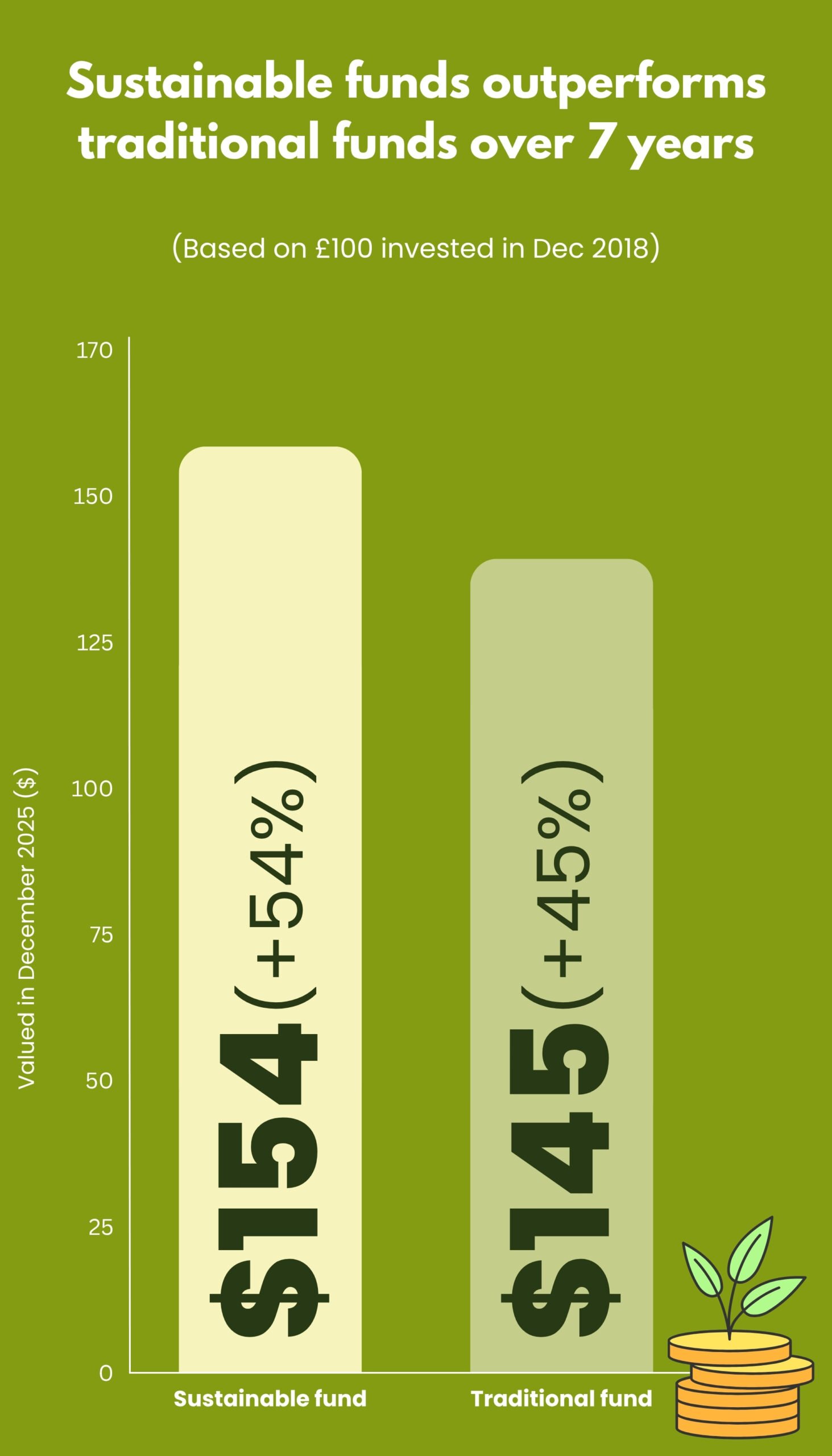
The debate over whether green money can outperform traditional benchmarks was settled by the data. Morgan Stanley’s Institute for Sustainable Investing, drawing on Morningstar’s global fund universe and updated in recent reports, found that $100 placed into a sustainable fund in December 2018 was worth $154 by the end of the tracking window. The same amount placed into a traditional fund over the same period returned $145.
That $9 gap, held across seven years of market volatility and a full cycle of interest rate rises, is not a values statement. It is a performance record. And the detail behind it matters more than the headline figure.
The outperformance was not driven by green hype or government subsidies. It was driven by capital preservation: the discipline of losing less during the chaos of the last three years than the market average. Sustainable funds are heavily weighted toward European and global markets, which account for 70 per cent of their allocations compared to just 40 per cent for traditional funds. That geographic positioning was a headwind in the second half of 2025, when those markets underperformed, but it was the engine of the strongest outperformance recorded since Morgan Stanley began tracking the data in 2019 during the first half of the year.
The long-term picture holds regardless. Female fund managers, who oversee a growing share of specialised climate and impact vehicles, have been the primary architects of this defensive alpha, or, in plain terms, making money by refusing to lose it. They have treated climate risk not as a moral obligation but as a fundamental accounting reality.
The Patient Capital Thesis
The prevailing investment philosophy of the last twenty years was built on speed. In the move-fast-and-break-things era, capital was deployed to capture markets before they were even fully understood. The climate transition, however, is a physical, industrial and multi-decade challenge. It does not obey the laws of software scaling.
The women leading the top-performing green funds in 2026 have moved away from the lottery ticket mentality. Instead, they apply what is now called the Patient Capital Thesis. It begins with deep diligence over first-mover advantage: a refusal to enter a deal until the underlying physics and regulatory pathways are fully de-risked. It prioritises infrastructure over applications, with a heavy focus on hard assets, grid upgrades, storage and circular materials, that provide repeatable contracted revenue rather than speculative growth. And it draws on decades of institutional discipline in risk management and corporate governance, allowing these managers to identify the structural flaws that younger, more aggressive peers routinely miss.
There is an important counter-narrative worth acknowledging. Global sustainable funds recorded net outflows of $62.8 billion in 2025, while traditional funds saw inflows across every quarter of the year. The political environment in the United States has placed pressure on ESG labelling, and some institutional investors have become more cautious about public association with sustainability mandates. Yet total assets under management in sustainable funds still grew to $4.13 trillion by the end of 2025, up 16.3 per cent year on year. Returns, not sentiment, drove that growth. The case being made here is not about popularity. It is about the quality of the underlying thesis.
The Women Steering the Capital
There is a well-documented pattern in investment research: female fund managers generally show lower portfolio turnover and higher adherence to their stated investment style. In 2026, that style discipline has become a competitive edge.
In a volatile market, the most expensive mistake an investor can make is style drift, chasing the latest trend out of fear of missing out. The successful climate funds of today are led by women who have spent decades learning how to say no. They are not interested in the most prominent hydrogen startup if the unit economics do not hold up. They are interested in the overlooked, load-bearing components of the energy transition that the broader market passed over.
Anne Simpson has spent the better part of her career making the case that climate risk is investment risk. As the architect of Climate Action 100+, a shareholder engagement coalition now representing more than $68 trillion in assets, and through her executive leadership at Franklin Templeton, she helped shift the vocabulary of institutional investment from responsible to rational before the returns data was there to confirm it.
Jenny Johnson, CEO of Franklin Templeton, oversees upwards of $1.7 trillion in assets and has integrated sustainability frameworks into the firm’s core investment process rather than treating them as a separate product category. Mellody Hobson, co-CEO and President of Ariel Investments, applies the same lens of mispriced risk to overlooked markets through the $1.45 billion Project Black Fund, built on the premise that markets habitually underprice what they do not bother to understand. That same instinct, applied to climate assets, is precisely what has driven the outperformance this article describes.
The Shift in Institutional Trust
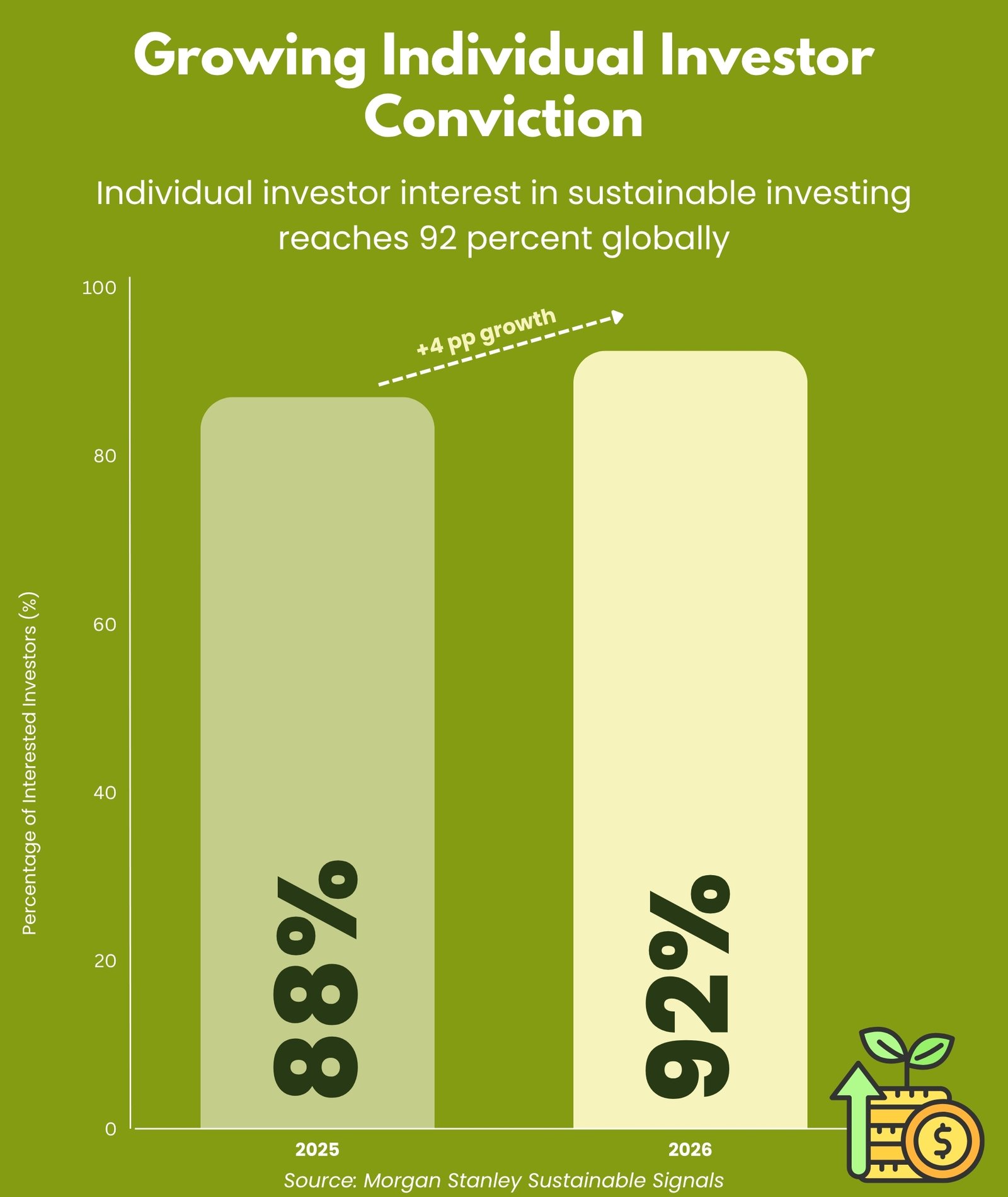
The institutional market is paying attention, and in 2026 the pressure is coming from both directions. Morgan Stanley’s Sustainable Signals: Individual Investors 2026 report, published this month, found that 92 per cent of individual investors globally are interested in sustainable investing, up four percentage points from last year, with performance cited as the primary driver. That rising retail conviction translates into bottom-up pressure on the pension fund trustees, insurance executives and LP committees who allocate capital on their behalf.
At the top of those institutions, the logic is sharper still. Pension funds and insurance companies operate under a strict fiduciary duty to match long-term assets against long-term liabilities, a discipline known as asset-liability management. The patient capital thesis, with its emphasis on contracted revenue, regulatory durability and thirty-year infrastructure assets, is a direct structural answer to that requirement. These institutions are not backing female-led climate funds because it is the right thing to do. They are backing them because patient capital is the architecture that fits their obligations.
They are backing the managers who treat climate finance like an engineering problem rather than a social movement. This generation of women has reframed the green investment narrative. It is no longer about doing good. It is about managing risk in an era where the climate is the ultimate risk factor.
The Final Word
The net-zero transition is the largest capital reallocation in human history. It will be won by those who can hold a position through volatility and capture the value at the end of a long horizon.
If you want to find the smartest money in 2026, look past the aggressive headlines and the disruptors. Look for the managers who have spent decades mastering the art of the patient bet. The head of the table is no longer reserved for the loudest voice. It belongs to the most patient one.