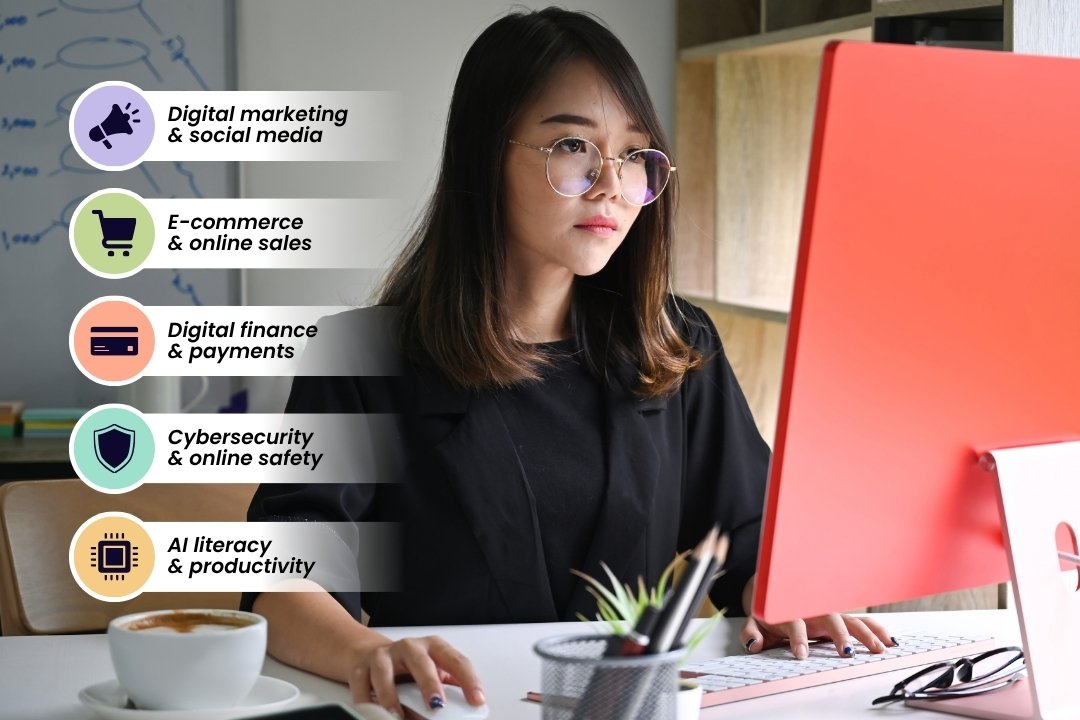

Digital technology has become part of almost every stage of running a business. A customer may discover a company through social media, contact it through a messaging platform, pay through a digital service, receive an invoice by email and leave a review online. Behind those interactions are a growing number of tools for marketing, accounting, customer management, research, payments and, increasingly, artificial intelligence.
For women entrepreneurs, however, participation in the digital economy still depends on more than simply having a smartphone or an internet connection. The ability to use digital tools confidently, safely and strategically is becoming an important business capability.
The scale of the access gap remains significant. The International Telecommunication Union estimates that about six billion people were using the internet in 2025, while 2.2 billion remained offline. Globally, 77 per cent of men used the internet compared with 71 per cent of women. The global gender parity score was 0.92 in 2025, unchanged from 2019, showing that growth in connectivity has not eliminated the gender gap.
The World Bank’s 2026 analysis of 81 low and middle income countries provides another measure of the challenge. Approximately 1.4 billion adults in those countries did not use the internet, including more than 800 million women. Importantly, 88 per cent of the people in this group lived in areas where broadband coverage was already available. The problem, therefore, is increasingly not only whether a network exists, but whether people can afford, access and confidently use digital services.
For women who are building businesses, that distinction matters.

Access is only the first step
Connectivity is a prerequisite for digital entrepreneurship, but access alone does not create digital capability.
The latest GSMA Mobile Gender Gap Report, published in 2026, found that 1.5 billion women in low and middle income countries were using mobile internet in 2025. Yet women were still 12 per cent less likely than men to use mobile internet, equivalent to around 200 million fewer women. Around 810 million women remained unconnected, with more than two thirds living in South Asia and Sub-Saharan Africa.
The same report found that the gender gap in smartphone ownership stood at 13 per cent in 2025, while the gender gap in overall mobile ownership was 7 per cent.
These figures matter to entrepreneurs because a smartphone can be a business tool as much as a communication device. For a small business owner, it can provide access to customers, banking, digital payments, advertising platforms, business education, suppliers and government services.
But having the device is only the beginning.
A business owner also needs to understand how to use the technology effectively. That means being able to search for reliable information, manage digital accounts, protect passwords, use online financial services, communicate professionally, evaluate information and learn new platforms as they emerge.
Digital literacy therefore needs to be understood as a business capability rather than simply a technical skill.

From digital confidence to digital business skills
The first layer of digital literacy is confidence.
For an entrepreneur, this can include knowing how to manage email, store documents securely, use cloud services, participate in video meetings, search for business information, create digital documents and use online communication tools.
The next step is applying those skills to business activity.
This could mean setting up a digital catalogue, accepting online payments, managing customer enquiries through messaging platforms, keeping electronic financial records or using a customer relationship management system.
The World Bank’s 2026 review of more than 100 digital literacy programmes found that effective programmes tend to combine practical learning with engagement and additional support. One example cited by the World Bank found that combining instructional videos with four weeks of hands-on facilitator support produced substantially stronger knowledge and practical skill application than video instruction alone.
This has an important implication for entrepreneurship programmes. Giving women access to a digital course is not necessarily enough. Training needs to show how a skill can solve an actual business problem.
Instead of teaching a spreadsheet as a software function, for example, training could show an entrepreneur how to use it to track sales and calculate margins. Instead of teaching social media in isolation, it could show how to create content, monitor engagement and turn enquiries into customers.
The objective is not simply digital familiarity. It is digital competence.

Turning social media into a business tool
Social media is already one of the most accessible digital channels for small businesses, particularly businesses that cannot afford conventional advertising.
Research by the Cherie Blair Foundation for Women, based on responses from 2,870 women entrepreneurs across 96 low and middle income countries, found that 88 per cent of respondents used WhatsApp for business and 74 per cent used Facebook. The research also found that digital tools, particularly social media marketing and digital payments, were identified as the top business success in 2024 by 63 per cent of respondents.
Yet using social media and understanding digital marketing are not the same thing.
Digital marketing skills can include identifying a target audience, creating useful content, understanding platform analytics, testing different messages, managing customer enquiries and measuring whether promotional activity produces sales.
For an entrepreneur, the difference can be substantial.
A business owner who simply posts photographs of products is using a digital platform. An entrepreneur who understands customer behaviour, measures engagement, tests content, manages enquiries and connects digital activity to sales is using that platform as part of a business strategy.
Training should therefore move beyond instructions such as how to create a post. Women entrepreneurs can benefit from learning how to determine what they should post, why they should post it, who they are trying to reach and what outcome they want.

E-commerce requires more than an online shop
The growth of digital commerce has created opportunities for small businesses to reach customers beyond their immediate geographical markets.
But moving online involves several skills.
Entrepreneurs need to understand digital product presentation, pricing, online payments, customer communication, delivery, returns, reviews, platform fees and basic data protection.
The Cherie Blair Foundation’s research found that only 31 per cent of surveyed women entrepreneurs used major e-commerce platforms such as Amazon, Alibaba or Jumia for business. The report identified transaction costs, concerns about online payments and complex onboarding processes among the barriers to adoption.
This illustrates why simply encouraging businesses to “go online” is insufficient.
A successful digital commerce programme should explain the economics of the platform as well as the technology. An entrepreneur needs to understand commission structures, customer acquisition costs, payment processing, delivery costs and the difference between revenue and profit.
Digital literacy becomes far more valuable when it is connected to commercial decision-making.

Digital Finance is now part of digital literacy
Financial technology has expanded the ways entrepreneurs can receive payments, manage money and access financial services.
The latest Global Findex 2025 data, based on nationally representative surveys of about 148,000 adults in 141 economies conducted during 2024, provides a broad picture of global financial and digital behaviour.
GSMA’s analysis of that data found that 18 per cent of adults in low and middle income countries held a mobile money account in 2024, compared with just 3 per cent a decade earlier. However, women in these countries were 36 per cent less likely than men to own a mobile money account, and the gender gap had widened from 30 per cent in 2021.
For women entrepreneurs, digital financial literacy can include understanding mobile money, online banking, payment gateways, electronic invoices, accounting platforms, transaction records and basic financial security.
It also means knowing how to recognise suspicious transactions, protect financial credentials and distinguish legitimate digital financial services from fraudulent offers.
Digital payments can create useful records of business activity, but entrepreneurs need to understand what those records show and how they can be incorporated into proper financial management.
A digital transaction is not automatically good financial management. The skill lies in understanding what the transaction means for cash flow, profitability and the wider business.

AI is creating a new layer of digital literacy
Artificial intelligence is changing the definition of digital skills.
For entrepreneurs, AI does not necessarily mean learning to build an AI model. It can mean understanding how to use existing tools to complete tasks that previously required more time, money or specialist assistance.
Possible applications include drafting marketing material, summarising documents, researching markets, analysing spreadsheets, preparing customer communications, translating content, developing product descriptions and automating routine administrative work.
But adoption and effective integration are different things.
A 2026 study by the Cherie Blair Foundation for Women, Intuit and the World Bank’s Women, Business and the Law project surveyed 3,072 women entrepreneurs across 66 low and middle income countries who were already digitally connected and relatively well educated. It found that AI use among this group had more than doubled in one year, from 38 per cent to 82 per cent, with 45 per cent reporting daily use. The researchers specifically caution that this was a digitally connected and relatively well educated segment of women entrepreneurs, rather than a representative sample of all women entrepreneurs.
The distinction is important.
The ability to use an AI tool does not automatically mean an entrepreneur knows whether its output is accurate, whether confidential information should be entered into it, whether generated material contains bias or whether the technology is actually improving the business.
AI literacy therefore needs to include verification, privacy, responsible use, data awareness and the ability to judge when human expertise is still required.
The Global Entrepreneurship Monitor’s 2024/2025 Women’s Entrepreneurship Report, drawing on 161,528 adults across 51 countries, found that women were 11 per cent less likely than men to see the benefits of AI for their businesses. The same report found women were less than half as likely as men to be active in the ICT sector.
The World Economic Forum’s 2026 Global Gender Gap Report adds another dimension. Among founders on LinkedIn, 8.7 per cent of female founders listed AI engineering skills in 2026, compared with 14.7 per cent of male founders. The figures were 2.3 per cent and 4.7 per cent respectively in 2019.
These figures measure AI engineering skills rather than general AI usage, so they should not be interpreted as evidence that only 8.7 per cent of female founders use AI. They do, however, indicate a persistent gender difference in specialised AI capability among founders.
That distinction is increasingly important as AI becomes part of mainstream business software.

Cybersecurity has to be part of the curriculum
Digital growth also creates new risks.
Entrepreneurs increasingly hold customer information, financial information, passwords, business documents and intellectual property online. A compromised email or social media account can therefore affect the entire business.
Cybersecurity literacy should cover strong and unique passwords, multi-factor authentication, phishing, suspicious links, account recovery, payment fraud, privacy settings and safe handling of customer information.
For women entrepreneurs, online safety can also have a direct effect on whether they participate in digital markets.
The Cherie Blair Foundation research found that 16 per cent of respondents identified safety and security concerns as a barrier to accessing mobile internet. Among those reporting safety concerns, 62 per cent said they had personally experienced online harassment. The report also found that privacy concerns influenced how women presented themselves and their businesses online.
Digital inclusion therefore has to include digital safety.
Teaching someone how to establish an online business without teaching them how to protect their accounts leaves a significant part of the job unfinished.
What should a digital skills programme teach?
A useful programme for women entrepreneurs should build skills progressively.
1. Digital foundations
Smartphone and computer use, email, internet searches, digital documents, cloud storage and online communication.
2. Digital business management
Online banking, digital payments, accounting software, invoicing, customer databases and basic business data.
3. Digital marketing
Social media strategy, content creation, analytics, search visibility, digital advertising and customer engagement.
4. E-commerce
Online shops, marketplaces, payment systems, pricing, fulfilment, customer reviews, returns and platform economics.
5. Data literacy
Understanding spreadsheets, basic business metrics, customer information and dashboards so entrepreneurs can make decisions based on evidence rather than assumptions.
6. AI literacy
Generative AI, research assistance, content creation, automation, data analysis, verification, privacy and responsible use.
7. Cybersecurity
Password management, multi-factor authentication, phishing awareness, fraud prevention, privacy and account recovery.
8. Digital leadership
Selecting technology, assessing software providers, managing digital teams, understanding technology costs and deciding when a new tool genuinely adds value.
The progression matters because not every entrepreneur needs the same level of technical knowledge. A local retailer may need strong digital payments and social media skills. A professional services firm may need CRM, data analysis and online marketing. A technology start-up may need a much deeper understanding of AI, cybersecurity and data infrastructure.

Training needs to reflect real business conditions
There is also a lesson in how digital skills are taught.
A 2026 randomised study published in The World Bank Economic Review compared app-based and in-person business training for women entrepreneurs. Although more than 75 per cent of participants took up the training, completion was 22 per cent for digital training compared with 71 per cent for in-person training. The study found limited effects on business knowledge or firm outcomes and suggested that digital delivery alone may not be sufficient.
That does not mean digital training is ineffective. It means that delivery matters.
The World Bank’s review of more than 100 programmes similarly points towards practical, engaging training combined with support such as mentoring, childcare, transport assistance and community engagement.
For women entrepreneurs, training may therefore work best when it is built around actual business problems.
A workshop could involve creating a real digital catalogue, setting up a secure payment method, analysing actual sales data or using AI to complete a genuine administrative task. Participants can then see the immediate connection between the skill and their business.
The goal is not to make every entrepreneur a technology expert
Digital literacy should not become another unrealistic requirement placed on women entrepreneurs.
The objective is not for every founder to become a programmer, cybersecurity specialist or AI engineer.
It is to ensure that entrepreneurs understand enough about the digital tools shaping their businesses to make informed decisions.
That includes knowing what technology can do, what it cannot do, what it costs, what risks it creates and when specialist help is required.
This is particularly important as technology becomes embedded into products that entrepreneurs already use. AI may increasingly appear inside accounting platforms, advertising systems, e-commerce tools and customer management software without being presented as a separate technology.
The entrepreneur may never need to build the technology. She will increasingly need to understand it.
From digital access to digital economic participation
The global picture is moving beyond the question of whether women are connected.
The more difficult question is whether women can use that connection to participate fully in economic activity.
The World Bank’s 2026 analysis estimates that 208 million additional women could come online if gender gaps in internet use were eliminated across countries where men currently have higher usage rates. The modelling is hypothetical, but it illustrates the scale of the potential opportunity.
At the same time, current research shows that connectivity without skills, safety and affordability does not automatically translate into business growth.
For women entrepreneurs, digital literacy is therefore becoming a combination of access, confidence, commercial knowledge, financial capability, cybersecurity and AI awareness.
The next generation of entrepreneurship programmes will need to recognise that distinction.
A smartphone can provide the connection. An internet service can provide the access. A digital platform can provide the marketplace.
But skills determine how effectively an entrepreneur can use all three.
As the digital economy continues to develop, the most important question may no longer be whether women entrepreneurs are using technology.
It may be whether they have the knowledge and confidence to use it to build, protect and scale businesses on their own terms.