
A German aerospace engineer has become the first wheelchair user to travel into space after taking part in a Blue Origin suborbital flight on Saturday.
The mission lifted off at 8:15 am (1415 GMT) from Blue Origin’s launch site in Texas. The flight, carried out using the company’s New Shepard rocket, lasted around 10 minutes and crossed the Karman line, the internationally recognised boundary of space.
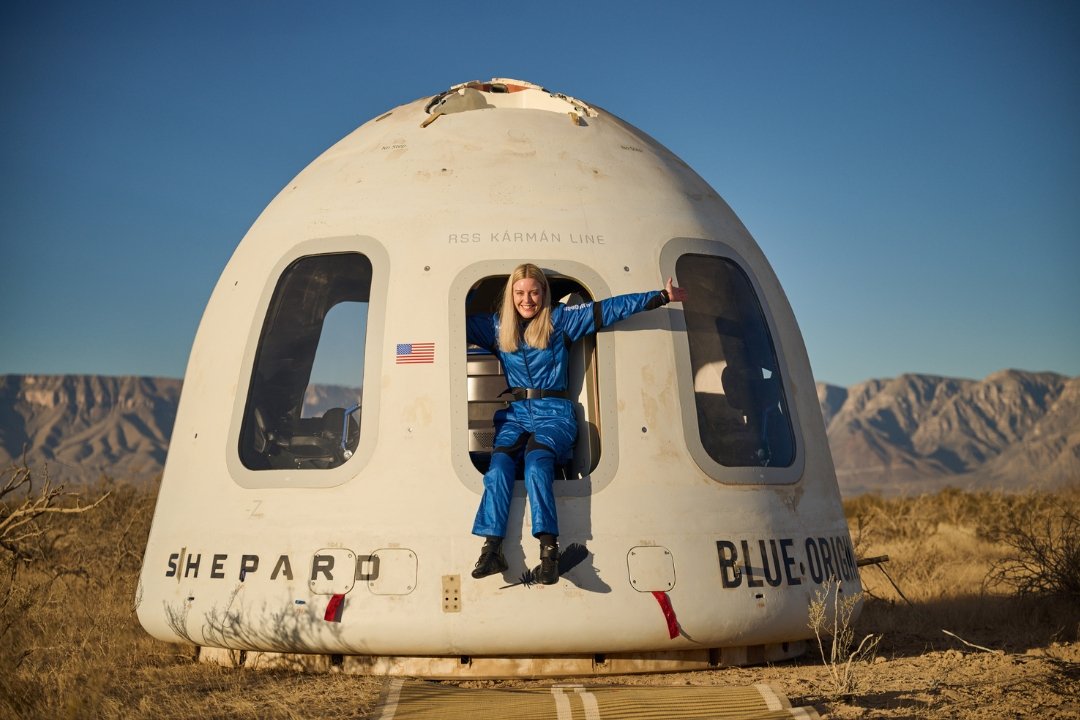
Among those on board was Michaela Benthaus, an aerospace and mechatronics engineer at the European Space Agency. Benthaus sustained a spinal cord injury following a mountain biking accident and now uses a wheelchair. Her participation marked a first in human spaceflight.
The New Shepard rocket, which is fully automated, launched vertically before the crew capsule separated mid-flight. The capsule later returned to Earth, descending gently into the Texas desert with the help of parachutes.
Speaking in a video released by Blue Origin ahead of the launch, Benthaus reflected on her experience of disability following her accident. “After my accident, I really, really figured out how inaccessible our world still is” for people with disabilities, she said. “If we want to be an inclusive society, we should be inclusive in every part, and not only in the parts we like to be,” Benthaus added.
This was the 16th crewed flight carried out by Blue Origin, the space company owned by Jeff Bezos. The company has been offering space tourism flights for several years, although ticket prices have not been made public. Dozens of people have already travelled to space aboard New Shepard, including pop singer Katy Perry and actor William Shatner, best known for playing Captain Kirk in “Star Trek”.
Following the mission, new NASA chief Jared Isaacman praised Benthaus’s achievement in a post on X. “Congratulations, Michi! You just inspired millions to look up and imagine what is possible,” he wrote.
Benthaus flew as part of the NS-37 crew, alongside Joey Hyde, Adonis Pouroulis, Hans Koenigsmann, Jason Stansell and Neal Milch. The inclusion of high-profile and diverse passengers is seen as part of Blue Origin’s efforts to maintain public interest as private space companies compete for attention.
While Virgin Galactic offers a similar suborbital experience, Blue Origin is also pursuing ambitions beyond tourism. Earlier this year, the company successfully completed two uncrewed orbital flights using its New Glenn rocket, which is significantly more powerful than New Shepard and positions Blue Origin to compete more directly with SpaceX in the orbital launch market.