

Artificial intelligence is becoming part of everyday working life. It is being used to analyse information, automate routine tasks, generate content, support decision-making and develop new products and services. As adoption grows, the skills people need to work effectively with technology are changing too.
For women, the shift presents both an opportunity and a risk.
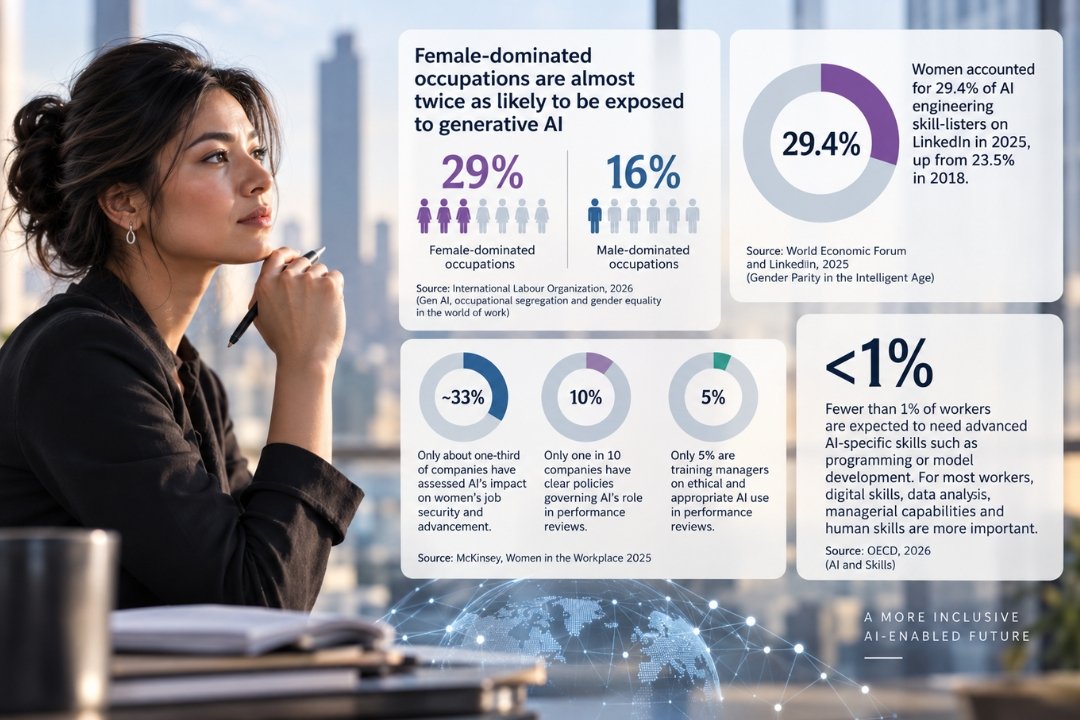
The International Labour Organization’s latest gender-focused research found that female-dominated occupations are almost twice as likely to be exposed to generative AI as male-dominated occupations. Around 29% of female-dominated occupations are exposed to GenAI, compared with 16% of male-dominated occupations. The ILO published this analysis in March 2026, building on its earlier research into generative AI and employment.
The finding does not mean that 29% of women’s jobs will disappear. In fact, the ILO says that, for most occupations, the most likely effect of GenAI will be changes to tasks, skills and working conditions rather than widespread job losses. The challenge is therefore not simply to protect existing jobs, but to make sure women have the skills and opportunities to benefit from the changes taking place.
So what should women be learning now?
AI literacy
The starting point is understanding how AI works and where it can be useful.
AI literacy does not mean becoming a machine learning engineer. It means understanding the basic capabilities and limitations of technologies such as generative AI, knowing what they can reasonably be used for and recognising when an output needs to be checked by a person.
This distinction is important.
The OECD’s June 2026 research on AI and skills found that fewer than 1% of workers are expected to need advanced AI-specific skills such as programming or model development. For most workers, the more important requirements are digital skills, the ability to use and interpret data, managerial capabilities and human skills including problem-solving, creativity and innovation.
For a marketing professional, AI literacy could mean understanding how to use generative AI for research, campaign development or content preparation. For a finance professional, it could mean understanding AI-assisted analysis while knowing when figures need independent verification. For an entrepreneur, it could mean identifying which parts of a business could benefit from automation.
The technology will vary by profession. The underlying skill is knowing how to work with it intelligently.
Better prompting and task framing
Prompting was one of the first AI skills to enter the mainstream conversation.
Knowing how to give an AI system a clear instruction remains useful, but professional AI use goes beyond writing clever prompts.
The more valuable skill is understanding how to frame a task.
A strong user can define the objective, provide relevant context, establish constraints, identify the desired format and then evaluate the result.
Consider a business owner asking an AI system to develop a marketing plan. A basic request might produce a generic strategy. A better approach would provide information about the target customer, product, budget, competitors and business objectives, then ask the system to identify assumptions and present several options.
The difference is not simply the prompt. It is the quality of the thinking behind it.
This is where existing professional expertise becomes important. AI can generate an answer, but the person using it needs enough subject knowledge to determine whether that answer makes sense.
Data literacy
AI is making it easier to process large quantities of information. That makes the ability to understand data more important, not less.
The OECD’s 2026 research identifies the ability to use, analyse and interpret data as an increasingly important skill as AI changes workplace requirements. It also notes that AI can increase demand for highly educated workers and that training is an important part of successful AI adoption.
Women moving into management and leadership therefore need to be comfortable with the numbers behind their organisations.
That could mean understanding customer acquisition, revenue, retention, productivity, employee data or operational performance.
But data literacy is not simply knowing how to read a dashboard. It means questioning what the numbers actually show.
Where did the data come from? Is it complete? What assumptions were used? Could the sample be biased? Does the conclusion follow from the evidence?
AI can make analysis faster. It cannot make poor data reliable.
AI-assisted productivity
One of the most accessible applications of AI is improving everyday work.
Research, summarising, drafting, organising information, preparing meeting notes and generating first versions of documents are examples of tasks where AI can assist.
The important word is assist.
A professional should not simply hand a task to an AI system and accept whatever comes back. The better approach is to use AI for appropriate parts of a workflow while retaining human review and responsibility.
The OECD’s 2026 research found that more than half of workers using AI reported receiving employer-funded training, and that workers who received training were more likely to report positive outcomes from AI adoption, including better job performance and working conditions.
For women, developing this capability can have a practical benefit: becoming faster and more effective at routine work can create more time for activities that require judgement, relationships and strategic thinking.
Workflow automation
The next step is moving from individual AI tasks to entire workflows.
A small business owner might use AI to help organise customer enquiries, prepare draft responses, analyse sales information and identify follow-up actions.
A marketing team might use AI at several points in a campaign, from initial research to content variations and performance analysis.
The skill is not learning every automation platform available. It is learning to recognise repetitive processes and assess whether they can be automated safely.
That requires an understanding of the business itself.
Someone who knows how a process works is often better placed to identify where AI can create value than someone who simply knows how to operate an AI tool.
Critical thinking
Perhaps the most important AI skill is one that existed long before AI: critical thinking.
Generative AI systems can produce information that sounds convincing while being inaccurate, incomplete or based on flawed assumptions.
Professionals therefore need to know when to question an answer, request evidence, cross-check information or seek specialist advice.
This is particularly important in fields such as healthcare, finance, law, human resources and public policy.
The ability to use AI responsibly includes knowing when not to trust it.
Cybersecurity and data protection
As AI becomes part of workplace systems, understanding what information can safely be shared with AI tools becomes increasingly important.
Employees and business owners may handle customer information, financial records, intellectual property or confidential company documents. Whether such information can be entered into an AI system depends on the tool, the organisation’s policies and applicable data protection requirements.
Women using AI at work should therefore understand their organisation’s rules, know what information is restricted and recognise common security threats.
For entrepreneurs, this is also a business issue. Customer trust can be damaged if sensitive information is handled carelessly.
AI literacy without basic security awareness is incomplete.
AI governance and ethical judgement
Women moving into management and executive roles will also need to understand how organisations govern AI.
That includes questions about bias, privacy, transparency, accountability and human oversight.
McKinsey’s Women in the Workplace 2025 research found that only about one-third of companies had assessed AI’s impact on women’s job security and opportunities for advancement. The same research found that only one in 10 companies had clear policies governing AI’s role in performance reviews, while only 5% were training managers on ethical and appropriate AI use in that process.
This matters because AI is not automatically neutral.
The ILO’s 2026 research notes that AI systems can reproduce existing social and economic biases, particularly when women are underrepresented in the development and deployment of these technologies.
Women in leadership therefore have an opportunity to influence not only whether their organisations use AI, but how they use it.
Women need opportunities to build AI, not just use it
There is another part of the conversation that is sometimes overlooked.
Women should not be seen only as workers who need to adapt to technology developed by others. They also need opportunities to become engineers, founders, investors, researchers, product leaders and decision-makers in the AI economy.
There has been measurable progress.
Research from the World Economic Forum and LinkedIn found that women accounted for 29.4% of AI engineering skill-listers on LinkedIn in 2025, compared with 23.5% in 2018. The gender gap narrowed over the five-year period in 74 of the 75 economies examined.
The progress is encouraging, but women remain a minority in AI engineering.
Greater participation matters because the people building and governing technology have an influence on how that technology develops and who benefits from it.
AI skills for women entrepreneurs
For women running businesses, AI can provide access to capabilities that previously required additional staff or specialist providers.
Depending on the business, AI can assist with market research, customer communications, administrative tasks, data analysis, content development, software development and other activities.
But using more AI tools does not automatically create a better business.
The real advantage comes from understanding where technology can solve a genuine problem.
A founder who understands her customers, knows her costs and can identify a repetitive process that is consuming valuable time may gain considerably more from AI than someone simply using it to generate large volumes of content.
Commercial judgement remains essential.
The human skills still matter
The rise of AI does not mean that human skills have become irrelevant.
The OECD’s 2026 research specifically identifies problem-solving, creativity and innovation, alongside managerial and digital capabilities, as important skills in an AI-driven workplace.
Communication, collaboration, leadership, negotiation and relationship-building remain important because businesses still operate through people.
AI can prepare information for a difficult meeting. It cannot take responsibility for the relationship.
It can suggest approaches to a negotiation. It cannot understand every human consideration involved.
It can generate ideas. It cannot automatically determine which idea is right for a particular organisation, customer or market.
The most valuable professionals are therefore unlikely to be those who choose between AI skills and human skills. They will be the ones who combine them.
The AI skills women should prioritise
There is no universal checklist because the right skills depend on someone’s profession and career stage. But a practical foundation includes:
AI literacy: Understanding what AI can do, where it can fail and how it is being used.
Task framing and prompting: Giving AI systems clear objectives, context and constraints.
Data literacy: Being able to understand, analyse and question data and AI-generated insights.
AI-assisted productivity: Using AI to support appropriate everyday tasks.
Workflow automation: Identifying repetitive processes that can potentially be streamlined.
Critical thinking: Checking outputs, challenging assumptions and verifying important information.
Cybersecurity awareness: Protecting confidential information and understanding AI-related security risks.
AI governance: Understanding bias, privacy, accountability and human oversight.
Strategic thinking: Recognising where AI can create genuine value rather than adopting technology simply because it is available.
Human leadership: Strengthening communication, creativity, collaboration, judgement and relationship-building.
The last category should not be treated as an afterthought. It is part of being effective in an AI-enabled workplace.
What women can do now
Learning AI does not require abandoning an existing career and starting again.
The most useful place to begin is often the work already being done.
Identify a few repetitive tasks in your role. Test whether AI can assist with one of them. Learn how to evaluate the output. Understand your employer’s policies. Improve your ability to work with data. Then look at whether AI can improve a larger workflow.
From there, develop one deeper AI capability connected to your profession.
A marketer could explore AI-supported customer research. An HR professional could learn about workforce analytics while understanding the risks of algorithmic decision-making. A finance professional could explore data analysis and automation. A lawyer could examine AI-assisted document work alongside confidentiality and verification requirements. A founder could investigate how AI could improve customer service or reduce administrative costs.
The goal is not to become an AI expert overnight.
It is to become a professional who understands how AI is changing her field and is capable of making informed decisions about what comes next.
The opportunity is bigger than learning another tool
AI is changing the workplace, but the future is not simply a competition between people and machines.
The more immediate challenge is deciding who has the skills to work effectively with AI, who gets access to training, who participates in building the technology and who has a voice in how it is deployed.
For women, that means the AI skills conversation needs to go beyond prompting.
It needs to include data, critical thinking, automation, cybersecurity, governance, entrepreneurship and leadership.
The ILO’s latest research makes clear that the impact of GenAI will not be gender-neutral. The OECD’s work shows that most workers do not need advanced AI engineering skills, but they do need stronger digital, data and human capabilities. Research from the World Economic Forum and LinkedIn shows that women are making progress in AI engineering, although they remain underrepresented.
The opportunity now is to make sure women are not simply prepared for an AI-shaped workplace.
They should have the skills, influence and confidence to help shape it.