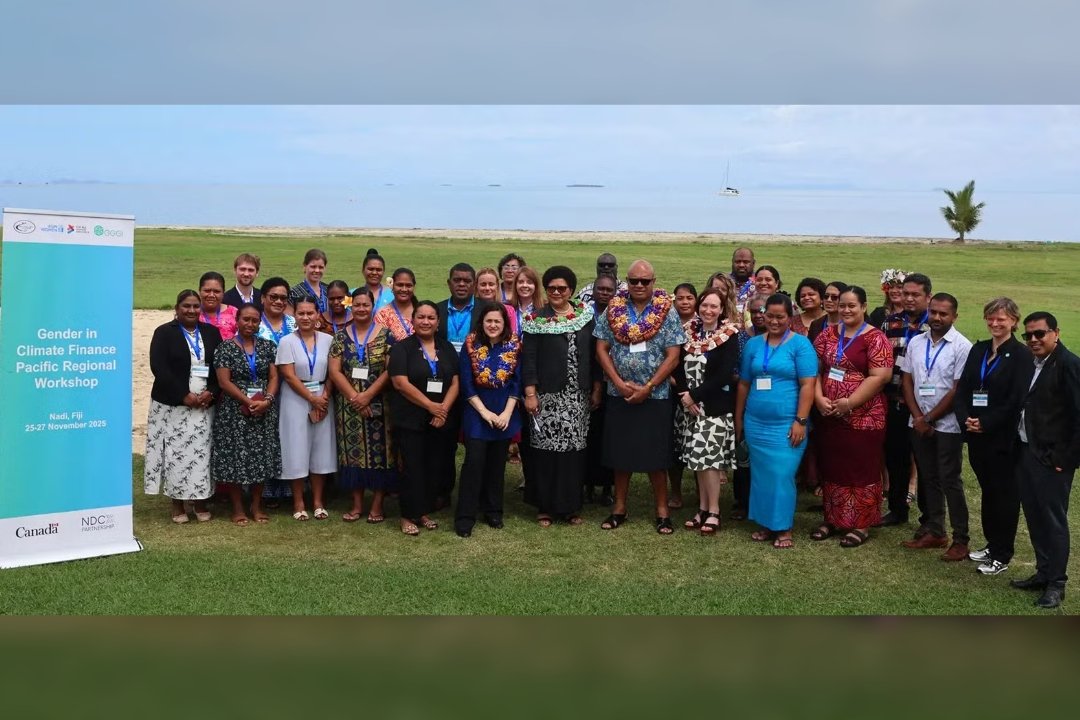

A regional training programme aimed at strengthening gender integration in climate finance has opened in Nadi, bringing together representatives from 16 Pacific Island nations for three days of capacity-building and policy discussions.
Running from 25 to 27 November, the Regional Capacity Strengthening Workshop on Gender Integration into Climate Finance in the Pacific is being organised jointly by the Fiji Ministry for Women, Children and Social Protection (MWCSP), the Global Green Growth Institute (GGGI), the NDC Partnership and UN Women, with backing from the Government of Canada.
Women and girls throughout the Pacific continue to experience the sharpest impacts of climate change, yet their perspectives and leadership are still unevenly included in climate-related financial decisions. Speaking at the opening session, Eseta Nadakuitavuki, Permanent Secretary for the Fiji MWCSP, drew attention to the need for gender considerations to be embedded in policy and project planning from the outset.
“Climate change is not gender neutral. Disasters are not gender neutral. Therefore, climate finance cannot be gender neutral,” she said. She added, “For climate finance to reach those who need it most, gender must be integrated from the start, not as an add-on, not as a paragraph at the end, but as the foundation of project design.”
The workshop marks a significant push to ensure that women are meaningfully involved in shaping, implementing and benefiting from climate finance and green growth programmes. It also reflects Fiji’s growing role in driving gender-responsive climate investments across the Pacific.
Ratu Sakiusa Tuisolia, Pacific Regional Director for GGGI, highlighted the need for institutions across the region to be prepared to deliver climate finance fairly and effectively. “As more climate finance becomes available, we must ensure our systems, institutions and people are ready and that they are designed in ways that reach those who need them the most,” he said.
Throughout the event, government officials, technical experts and regional stakeholders will take part in panel discussions and hands-on sessions touching on areas such as gender metrics in climate finance instruments, the development of green growth strategies that uplift women entrepreneurs, mobilising private investment for inclusive climate initiatives, and strengthening government systems to track gender outcomes.
The opening day also coincided with the International Day for the Elimination of Violence Against Women, which marks the start of the 16 Days of Activism against Gender-Based Violence. This context set the tone for discussions on the role of women in climate resilience. UN Women Fiji MCO Representative Alison Davidian stressed the consequences of failing to design equitable financial mechanisms.
“If we don’t get climate finance right, we risk failing women, communities and the very future we claim to be protecting. And the conditions that make the 16 Days necessary will deepen, especially for women across the Pacific whose daily lives are already shaped by climate shocks,” she said.
The programme also includes regional examples and private sector presentations that show how Pacific governments, development partners and businesses are jointly shaping climate solutions that place women and girls at the centre.
Amanda Mckee, Director of Knowledge and Learning at the NDC Partnership, noted: “The NDC Partnership continues to demonstrate that committing to gender equality in climate action offers a proven pathway to ensure climate efforts are sustainable over the long-term. Innovative, gender-responsive climate solutions are emerging across our membership, resulting in prioritization of gender in project planning, cross-government strategy documents and whole-of-government capacity building efforts.”
By the end of the workshop, participants plan to agree on a shared roadmap to expand gender-responsive climate finance pipelines across Fiji and the wider Pacific. The roadmap aims to support fresh investment, widen access for women-led projects and strengthen transparent, gender-accountable financing.