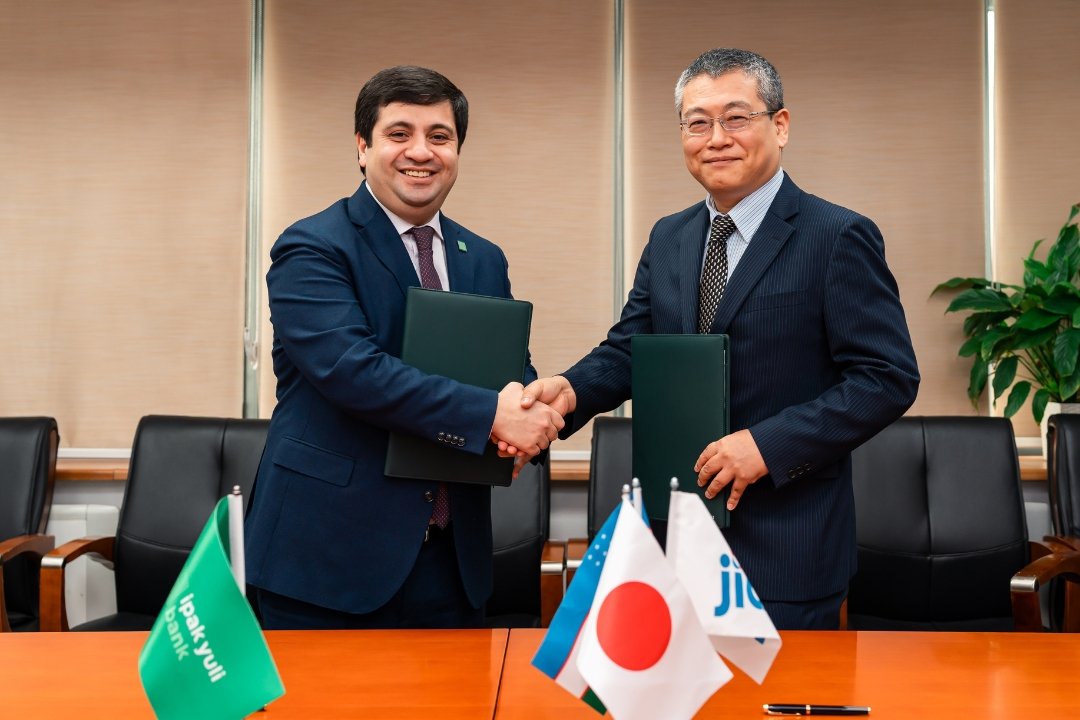

The Japan International Cooperation Agency (JICA) has signed a loan agreement with the Joint-Stock Innovation Commercial Bank “Ipak Yuli” (IYB) to support financial inclusion for youth and women-led micro, small and medium-sized enterprises (MSMEs) in Uzbekistan. The agreement was signed on December 15, with a formal signing ceremony held in Tashkent on December 22.
The ceremony was attended by senior representatives from both organisations, including Mr. Saidabror Saydakhmedov, Chairman of the Board and CEO of IYB, and Yoshibumi Bito, Chief Representative of the JICA Uzbekistan Office, alongside other officials. The project has also received international recognition, having been referenced in the joint statement issued during the Japan-Uzbekistan Summit Meeting on December 20.
The loan, valued at 25 million USD, is co-financed with the International Finance Corporation (IFC). It is aimed at improving access to finance for MSMEs across Uzbekistan, with a particular focus on enterprises led by young entrepreneurs and women. By providing funding to IYB, a private commercial bank with an active presence in the local market, the project seeks to address financing gaps faced by these groups and support long-term economic development.
Uzbekistan, a resource-rich country experiencing significant population growth, has prioritised private sector development as part of its broader economic strategy. Access to finance remains a key challenge for many MSMEs, particularly those led by youth and women. This project is intended to respond to that challenge by channelling funds through IYB to eligible businesses nationwide.
Under the project framework, financing provided by JICA will be allocated by IYB to MSMEs operating across the country. At least 50% of the JICA funds will be directed specifically to youth-led MSMEs and women-led MSMEs. The initiative is expected to contribute to sustainable economic growth by supporting entrepreneurship, job creation and business expansion.
The project also aligns with several Sustainable Development Goals (SDGs), including Goal 5 on gender equality, Goal 8 on decent work and economic growth, and Goal 17 on partnerships for the goals. In addition, it contributes to the “G7 2X Challenge: Financing for Women”, an initiative involving JICA and other G7 development finance institutions that aims to increase funding for women’s economic empowerment through entrepreneurship, leadership and labour market participation. As IYB actively finances women-led MSMEs, the project supports the objectives of this initiative.
Through this agreement, JICA and its partners aim to strengthen the role of the private sector in Uzbekistan’s development while expanding financial opportunities for underrepresented entrepreneurs.