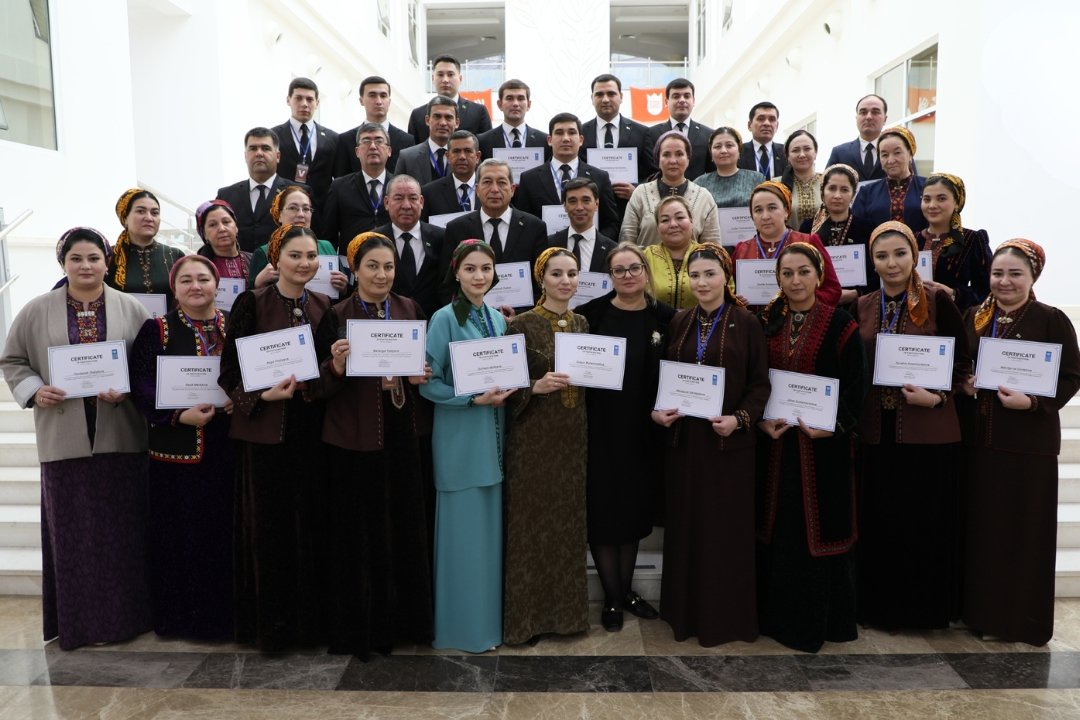

A roundtable and training workshop aimed at widening women’s participation in Turkmenistan’s political and public sectors has taken place in Ashgabat as part of a joint initiative between the United Nations Development Programme (UNDP) and the Central Election Commission (CEC).
The two-day event, held on 8–9 December 2025, forms part of the ongoing project: “Assistance in Capacity Building of the Central Commission for Holding Elections and Referendums in Turkmenistan.” Representatives from the CEC, regional election bodies and several political parties attended, including delegates from the Democratic Party of Turkmenistan, the Party of Industrialists and Entrepreneurs, and the Agrarian Party of Turkmenistan.
The workshop focused on Temporary Special Measures (TSMs) as a mechanism to increase women’s political engagement, including approaches such as legislative quotas. Participants received guidance from an international expert and reviewed the draft Analysis and Recommendations on the Introduction of Temporary Special Measures in Turkmenistan, discussing both global practice and potential national application.
“Temporary Special Measures, recognized under the Convention on the Elimination of All Forms of Discrimination Against Women (CEDAW), are a proven tool to break barriers and ensure women’s fair participation in political life. By introducing quotas and placement rules, countries in Central Asia, including Turkmenistan, are achieving visible results, and advancing global commitments under CEDAW and the SDGs,”said Tomica Paovic, UNDP Deputy Resident Representative in Turkmenistan, opening the event. “UNDP will continue to support Turkmenistan’s efforts to strengthen democratic institutions and promote international standards, including advancing women’s participation in political and public life.”
The workshop aligns with Turkmenistan’s ongoing work to implement its National Action Plan on Gender Equality, as well as its broader commitments under CEDAW and the Sustainable Development Goals. According to UNDP, support will continue in areas such as promoting TSMs, improving monitoring and accountability systems, strengthening leadership development for women, and increasing coordination between national institutions and development partners.
The initiative is intended to contribute to more inclusive governance structures and create opportunities for women to take on greater roles in public decision-making across the country.