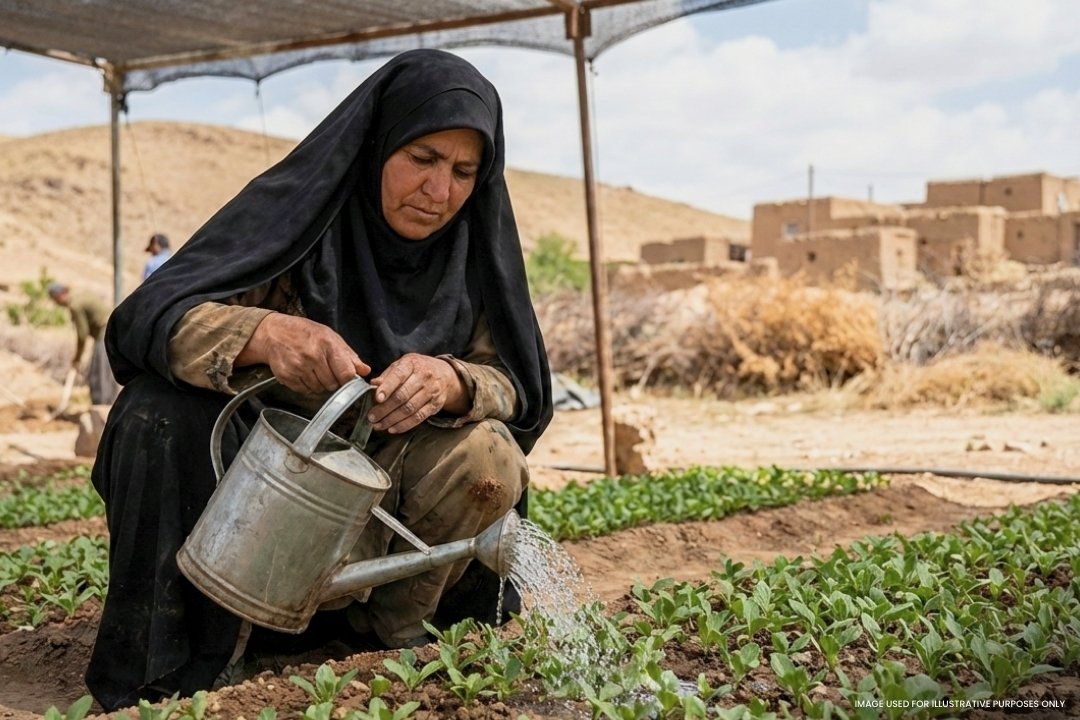

UN-Habitat, with support from the Government of Japan, has launched a women-led tree nursery in Sayeh-Khosh village in southern Hormozgan province, aiming to strengthen local livelihoods while improving environmental resilience.
According to UN-Habitat Iran, the nursery will produce around 40,000 climate-resilient seedlings each year. The organisation said the project is intended to help women develop climate-smart income opportunities, turning post-disaster rebuilding into a platform for growth and stability.
The initiative sits within the ‘Emergency Support for Post-Earthquake Reconstruction of Human Settlements in Hormozgan Province,’ known as the PERHOPE project, and is designed to link recovery efforts with long-term community benefits.
The programme is being delivered in collaboration with the Ministry of Roads and Urban Development, National Water and Wastewater Company, Hormozgan Water and Wastewater Company, local councils and NGOs. It aims to show how nature-based approaches, including greywater treatment, can support employment, address drought and desertification, and advance progress toward the Sustainable Development Goals.
Through PERHOPE, a nature-based greywater treatment system has been installed to convert ablution wastewater and AC condensate from Sayeh-Khosh Grand mosque into usable water for green spaces and nursery operations. Local women played a key role in shaping the system, which uses biofilters such as wood chips and charcoal to ensure it remains environmentally responsible and practical to maintain.
UN-Habitat notes that the project reflects wider ambitions to increase resilience in water-sensitive communities, while highlighting the impact of women-led collaboration and international partnership. The approach is being viewed as one that could be adapted for other buildings and regions if successful.
The PREHOPE project was created by UN-Habitat in cooperation with the Ministry of Foreign Affairs (MFA), Ministry of Roads and Urban Development (MoRUD), Ministry of Energy (MoE), Hormozgan Province Water and Wastewater Company (HPWWC), National Habitat Committee (NHC), and other partners. It forms part of the response to the July 2022 earthquakes that struck Lengeh County in Hormozgan Province.
Funded by the Government of Japan, the programme combines disaster recovery with sustainable development, aiming to support both immediate reconstruction and longer-term resilience through a “building back better” approach.
The project focuses on two main outcomes. The first is restoring access to potable water through post-earthquake reconstruction of the water supply system, including the construction of a 500m³ reinforced concrete reservoir and repairs to damaged infrastructure. This is expected to secure drinking water for approximately 1,500 residents.
The second outcome covers adaptation and capacity development to help communities prepare for climate risks and natural disasters. This includes studies and plans addressing housing, water systems, energy, and new livelihood opportunities.
A participatory approach has been used throughout, involving community members and local stakeholders to ensure activities match local priorities and support sustainable recovery.