Dr. Jane Goodall, the English ethologist and conservationist, was a globally renowned figure in the world of science and environmentalism. Besides being the founder of the Jane Goodall Institute and a UN Messenger of Peace, she was most recognised for her discoveries about chimpanzees through an extensive study and observation of wildlife.
Equipped with a notebook, binoculars, and a rare kind of patience, Dr. Jane Goodall arrived on the shores of Gombe, Tanzania, in 1960. What began as a six-month expedition to study chimpanzees in the Gombe reserve became a 26-year study that transformed science, culminating in her 1986 book ‘The Chimpanzees of Gombe: Patterns of Behavior.’ Her five observations and discoveries about chimpanzees reshaped our understanding of intelligence and wildlife at large.
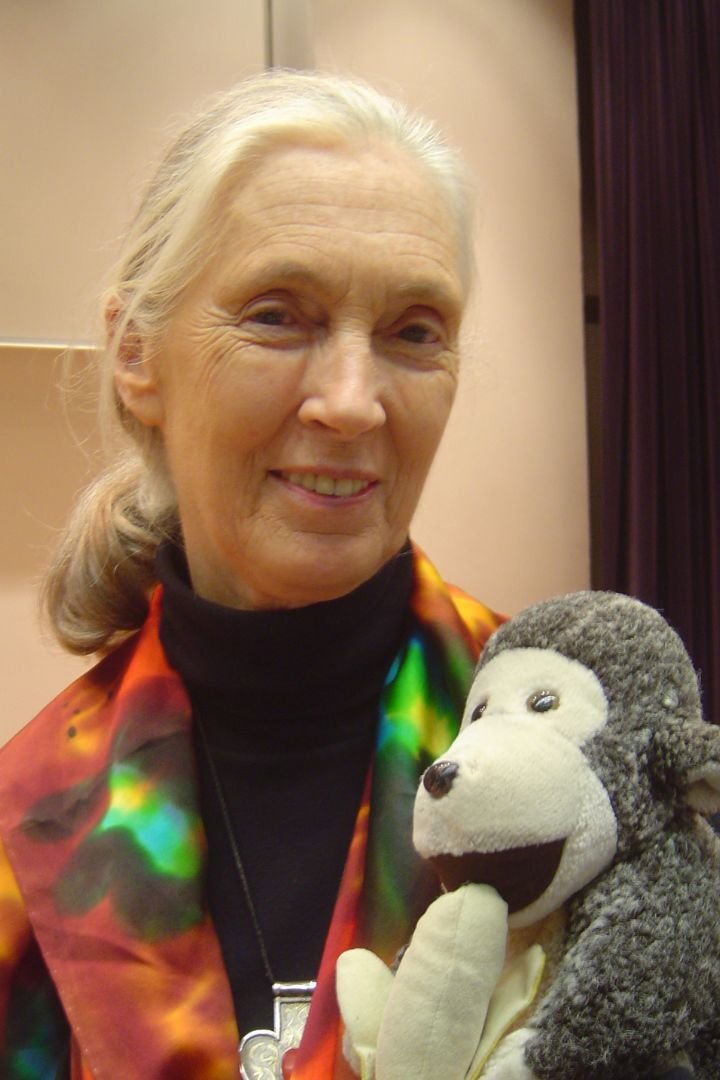
Image source: Jeekc/Wikimedia Commons
She discovered that chimpanzees make and use tools (a behaviour once thought unique to humans); they were omnivores rather than herbivores as previously believed; they were similar to humans in their tendency to wage war within the species; they too have strong familial bonds (such as between mother and child, or between siblings); and that they displayed compassion and emotions which were thought of as exclusively human. These discoveries rewrote textbooks and revolutionised science. Today, her research remains the world’s longest-running study of wild chimpanzees.
Her discoveries led to the creation of the Jane Goodall Institute, now active in 24 countries, and later, Roots & Shoots, a youth programme encouraging young people to protect animals, people, and the environment. These efforts reflect her belief that “Every individual matters, Every individual has a role to play. Every individual makes a difference.”
When Dr. Jane Goodall passed away at 91, the world didn’t just lose a scientist, it lost a moral compass. Tributes poured in from Sir David Attenborough, Prince William, Barack Obama, and Leonardo DiCaprio. Each echoed the same sentiment: Goodall didn’t just study life; she helped us understand what it means to be part of it.
Influence beyond science
Goodall’s reach extended into the highest echelons of power. She shared stages with world leaders, advised the United Nations, and collaborated with tech giants. Her partnership with Amazon Web Services (AWS) saw six decades of her handwritten research digitised using AI, preserving vital ecological data for scientists worldwide.
Her friendships with Attenborough and Prince William reflected mutual respect for conservation and global education. “She challenged us all to make a difference,” the Prince wrote on X. Barack Obama credited her with “opening doors for generations of women in science.”
For Goodall, hope was not naïve, it was strategic. “What gives you hope?” she would ask, waiting for the silence that followed. She understood that true change depends not just on outrage but on persistence.
Dr. Jane Goodall’s lessons in leadership
For leaders in business and beyond, Goodall’s story in the world of science and conservation offers more than inspiration. Her legacy teaches the principles of long-term thinking, empathy, and purpose, all increasingly essential in modern business leadership. Some such tenets include:
Leading with curiosity. When Goodall named chimpanzees and watched them as individuals rather than research subjects, she defied convention. Research from Harvard Business School also depicts that the same kind of curiosity helps leaders make better decisions, be more innovative, and adapt quickly.
Courage over conformity. Early critics dismissed her methods as “unscientific.” Yet she persisted, proving that courage drives progress. Her resilience mirrors today’s ESG pioneers who champion ethical supply chains. Sources have also found that companies with strong ESG practices often outperform their peers, and that firms with high ESG ratings had 20% higher market capitalisation.
Thinking in systems. Goodall reminded us that “we are part of the natural world, not separate from it.” Today, systems thinking is central to business sustainability, helping firms anticipate ripple effects across markets and ecosystems.
Building trust through empathy. Her ability to gain the trust of wild chimpanzees wasn’t just a scientific feat, but also a lesson in listening. A skill that matters just as much in the workplace. Modern data reinforces this: 61% of employees with empathetic leaders report higher innovation and job satisfaction, as opposed to 13% of those without empathetic leaders. Similarly, 76% of employees with empathetic leaders report higher levels of engagement as compared to 32% of those without.
Anchoring leadership on purpose. From her Gombe research to global activism, Goodall believed that purpose drives endurance. Similarly, organisations guided by purpose see similar benefits, including stronger workforce retention.
“You cannot get through a single day without having an impact. You have to decide what kind of difference you want to make.”
– Dr. Jane Goodall
A blueprint for business sustainability
Dr. Jane Goodall’s ideas and work aligned with the UN Sustainable Development Goals (SDGs): particularly SDG 13 (Climate Action) and SDG 15 (Life on Land). Her message of balancing human progress with ecological responsibility is the foundation of modern ESG frameworks.
For businesses, this means integrating conservation into operations, from carbon-neutral practices to community engagement. The UN Global Compact reports that 99% of CEOs now view sustainability as critical to business success and plan to expand their ESG initiatives. Goodall’s approach has become the moral and strategic compass of modern enterprise.
As the Jane Goodall Institute continues its mission, businesses have a clear call to action: take her model of empathy-driven leadership and turn it into measurable impact. Her work reminds us that corporate growth and planetary health are not opposing goals, but they are interdependent.
Remembering Dr. Jane
Dr. Goodall’s 65-year journey reshaped not only our understanding of animals but also reflects our view of ourselves. She saw equality and environmental justice as intertwined.
She taught the world that peace begins with understanding, that leadership begins with listening, and that change begins with small, deliberate acts of care. In the forests of Gombe, she found more than chimpanzees, she found humanity.
And that, perhaps, is why her absence feels so profound.