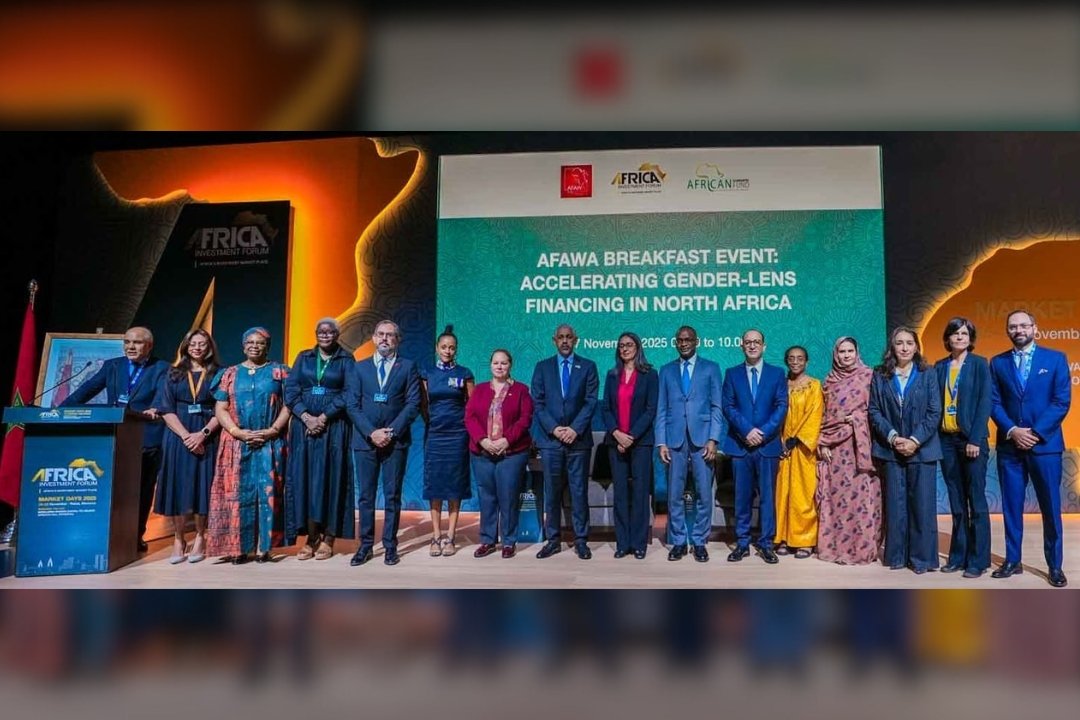

A high-level breakfast meeting held during the Africa Investment Forum Market Days brought together senior bankers, policymakers, development finance leaders, civil society groups and women entrepreneurs to advance gender-lens financing across North Africa.
Opening the session, Morocco’s Minister of Economy and Finance, Nadia Fettah, called for more decisive action, stating: “Women have nothing left to prove. They have already done their part of the work. It is up to the ecosystem to recognize that the talent is there, that the innovation is there, that the desire is there.”
She added: “When we encourage and promote women’s entrepreneurship and women’s business financing, it is not to correct an injustice, it is to amplify the future, growth and ambition of our continent.”
The event was convened by the African Development Bank Group’s Affirmative Finance Action for Women in Africa (AFAWA) initiative in partnership with the African Guarantee Fund. A central theme throughout the discussions was the persistent perception gap within financial institutions. Despite consistent evidence pointing to women entrepreneurs as a low-risk, high-return segment, many banks continue to treat them as high-risk candidates.
Minister Fettah highlighted these challenges in Morocco, noting that only 11% of women-owned businesses in the country secure financing. She stressed that if bank managers properly assessed women-led enterprises, they would see that their risk levels were not higher than others.
African Development Bank President, Dr Sidi Ould Tah, reaffirmed the institution’s long-term commitment to AFAWA, pointing to its tangible progress. “The African Development Bank Group, under my direction, will continue to accord paramount importance to this initiative,” he said. Dr Ould Tah also pledged to expand guarantee mechanisms to make finance more accessible to women without requiring collateral.
Jules Ngankam, Group CEO of the African Guarantee Fund, detailed the ongoing achievements of the AFAWA Guarantee for Growth (G4G) programme. “Women in Africa have the highest participation in economic activity in the world. The average in Africa is 65%, and the global average is 47%. Nevertheless, their contribution to GDP is very low,” he said.
AFAWA aims to unlock $5 billion in financing for women entrepreneurs. Of this, $2.8 billion has already been approved and $1.3 billion disbursed. A significant share of the initiative’s impact stems from G4G, which has collaborated with more than 100 financial institutions since 2021 to channel $800 million to 12,000 women entrepreneurs. The programme is targeting a total disbursement of $3 billion. In parallel, the African Development Bank is directing an additional $2 billion to women-led businesses through instruments including credit lines, equity investments and trade finance facilities.
During a panel discussion, financial sector leaders addressed persistent barriers on both the supply and demand sides. Omar Shawki, Managing Partner at ForvisMazars, noted that many women-led enterprises face challenges linked to incomplete financial documentation or lack of formal business registration, having operated informally for extended periods. Panellists also pointed to unconscious bias within banking systems as a major obstacle to progress.
Government representatives from Morocco and Mauritania outlined forthcoming steps, including new guarantee partnerships and plans to expand financing for women-led SMEs.
Speakers also drew attention to the growing success of gender bonds as a financing instrument on the continent. Examples highlighted during the session included:
- Morocco’s CIH Bank issuing Africa’s first gender bond in 2021, raising $20 million.
- Equity Bank’s $32 million gender bond, the first in sub-Saharan Africa.
- Ecobank’s $16 million gender bond issuance in West Africa.
All three issuances were oversubscribed. Speakers urged participants to make measurable commitments to gender-bond investment ahead of the next Africa Investment Forum.
The session closed with a collective call for more structural reform, improved financial instruments and sustained engagement between governments, banks and development partners to advance women’s economic participation across North Africa.